
Hospital Oxygen Cylinder Requirements. Calculation for 10-30 Beds

The Short Answer First
A 15-bed hospital never uses the same amount of oxygen two days in a row. On a quiet afternoon one D-Type cylinder might last the whole shift; on a bad night, the ICU and the emergency room together can drain the rack faster than the refill van can get back. Administrators who plan medical oxygen stock from memory end up in one of two traps: overstocking and locking up money in idle cylinders, or understocking and risking a patient crisis.
This guide explains how to calculate hospital oxygen cylinder requirements for 10, 15, 20 and 30 bed hospitals. You will get the typical flow rates used in wards, ICUs, emergency rooms and operation theatres, the cylinder math for B-Type and D-Type cylinders, and backup stocking rules that keep a small hospital safe through surges.
For a typical small hospital with a normal bed mix, plan on roughly this many D-Type cylinders per day, before safety margins:
- 10 beds: about 7 D-Type cylinders per day
- 15 beds: about 10 D-Type cylinders per day
- 20 beds: about 13 D-Type cylinders per day
- 30 beds: about 19 D-Type cylinders per day
Those figures assume a typical mix of occupied and empty beds, with a realistic share of beds actually on oxygen at any moment. The usage factors in the worksheet below already absorb normal occupancy swings, so you apply them once, not twice. Your own numbers will differ based on how many ICU beds you run, how busy your emergency room is, and what your doctors prescribe. The section below walks through the calculation so you can plug in your own hospital's numbers instead of trusting a generic estimate.
Know Your Cylinder: B-Type and D-Type
Every hospital oxygen plan starts with the two cylinder sizes that dominate small facilities: the medical oxygen cylinder sizes - B-Type (10L) and D-Type (46.7L).
- B-Type cylinder: 10 litre water capacity, roughly 1,500 litres (1.5 m3) of oxygen when full. Portable and easy to lift, so it is used for patient transfers, ambulances, bedside short-term use, and as a standby on emergency trolleys.
- D-Type cylinder: 46.7 litre water capacity, roughly 7,000 litres (7 m3) of oxygen when full. Heavy and meant to stay put, this is the workhorse for hospital manifolds, ICU beds, emergency rooms and any high-usage point.
The core formula for duration is simple: cylinder capacity in litres divided by flow rate in litres per minute, divided by 60, gives hours of supply.
- D-Type at 2 L/min: about 58 hours
- D-Type at 5 L/min: about 23 hours
- D-Type at 10 L/min: about 12 hours
- B-Type at 2 L/min: about 12.5 hours
- B-Type at 5 L/min: about 5 hours
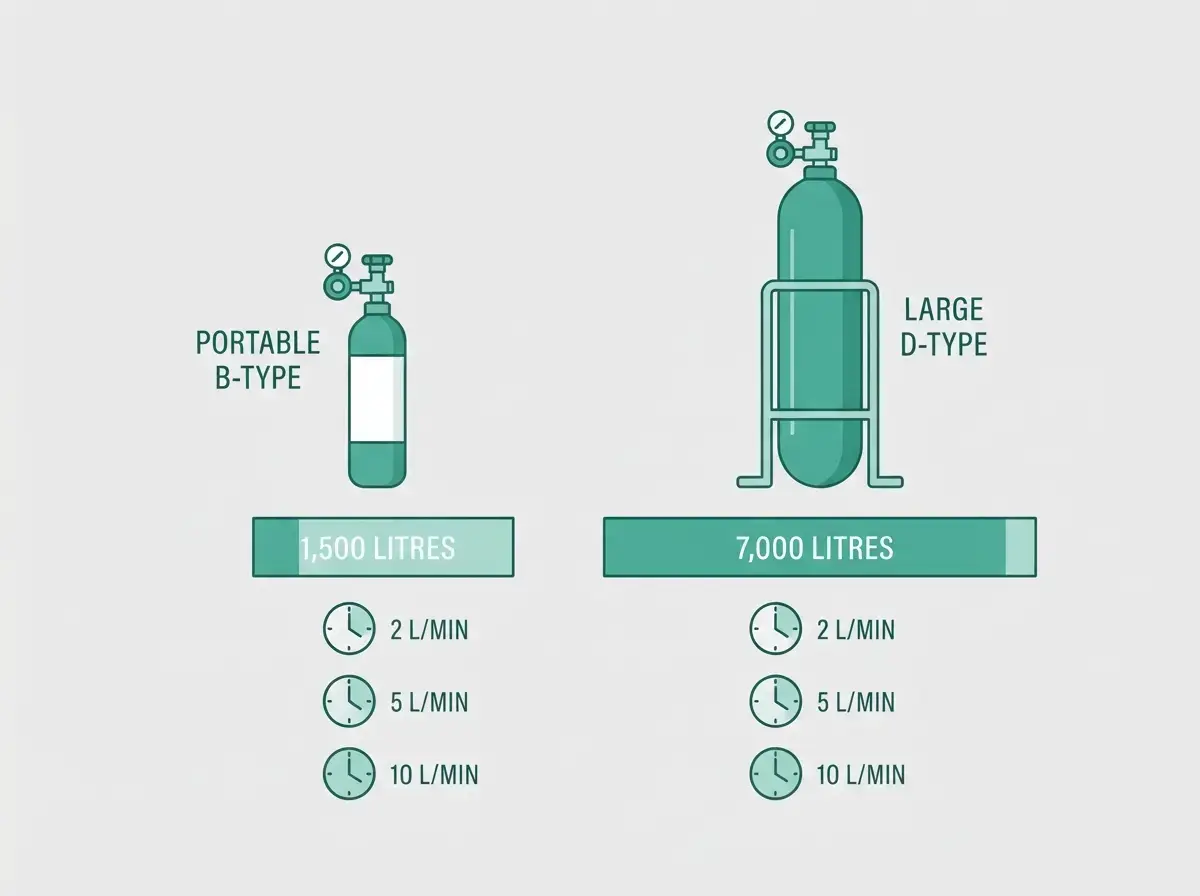
You can also read a partially used cylinder. Remaining litres roughly equals water capacity multiplied by the pressure shown on the gauge in bar. A D-Type at 100 bar holds about 4,670 litres, which is about 15.5 hours at 5 L/min. That is why every cylinder should stay paired with a working pressure gauge, not just a regulator.
Typical Oxygen Flow Rates by Hospital Area
Actual flow rates are always set by the treating clinician, so treat this section as planning guidance, not prescription. It follows the standard delivery ranges in the WHO-UNICEF oxygen therapy device guidance: nasal cannula 1-6 L/min, simple face mask 6-10 L/min, and non-rebreather mask 10-15 L/min.
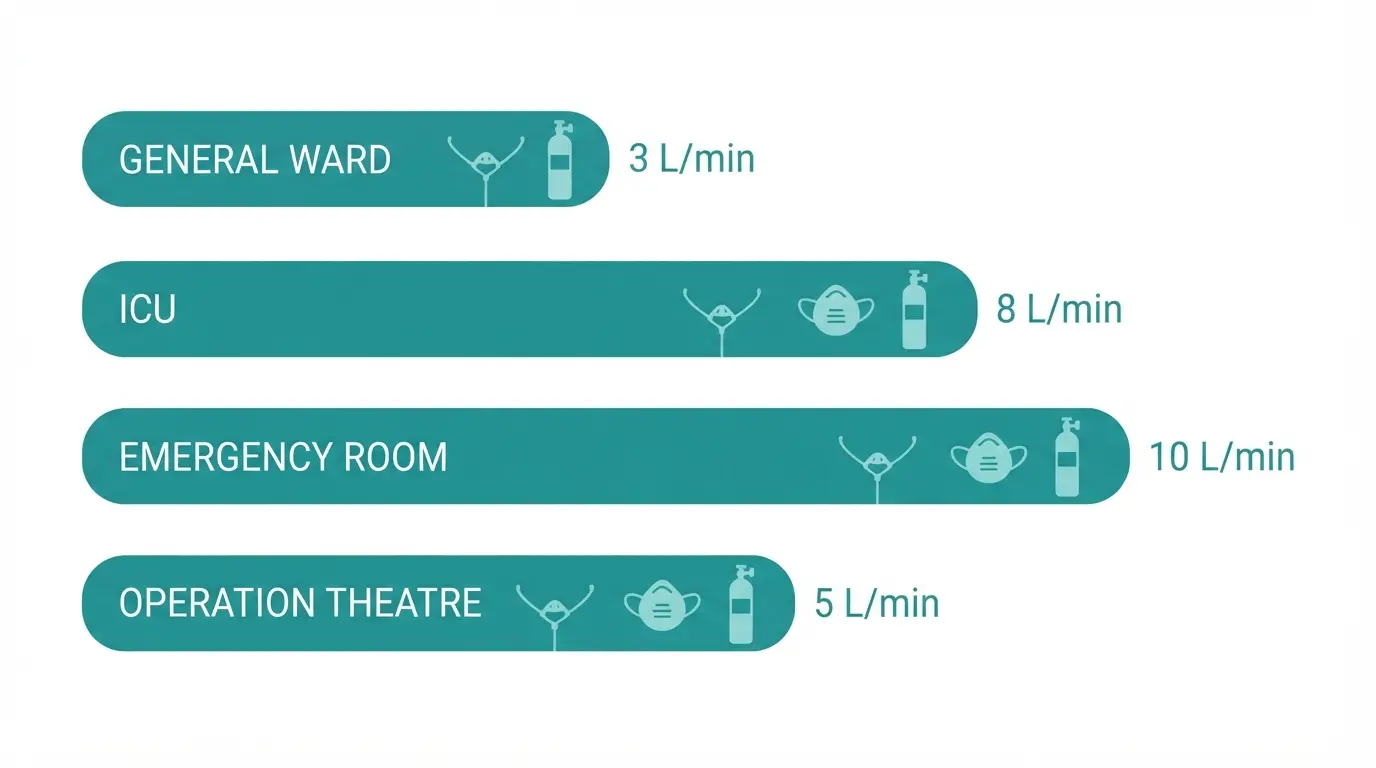
For planning, use these practical averages:
- General ward: 3 L/min average per bed on oxygen
- ICU: 8 L/min average per occupied bed
- Emergency room: 10 L/min average while a bed is in use
- Operation theatre: 5 L/min per table during the operating day
One useful cross-check comes from the Government of India's own hospital planning formula, which used 7.14 L/min for non-ICU beds and 11.9 L/min for ICU beds (see the Ministry of Health letter detailing the calculation). It is a deliberately conservative figure meant for surge conditions, and it is a good stress test for your backup plan.
To set and control these flows accurately, every outlet needs proper hardware: oxygen regulators and flowmeters matched to the cylinder, and medical oxygen flowmeters that let staff dial in the exact litres per minute without guesswork. A leaking or mismatched regulator silently inflates consumption.
Hospital Oxygen Cylinder Requirement: Six-Step Worksheet
Work through these steps with your own numbers.
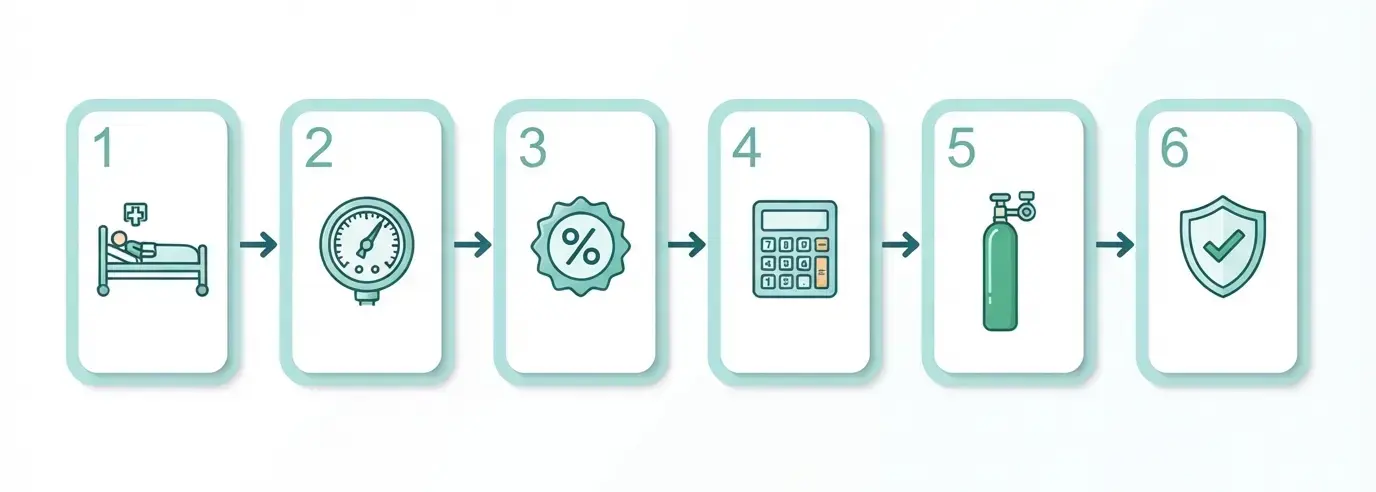
Step 1: List your areas and bed counts. Write down ICU beds, emergency beds, general ward beds, and operation theatre tables separately. A ward bed and an ICU bed consume oxygen at very different rates.
Step 2: Assign a planning flow rate to each area. Use the averages above unless your doctors tell you otherwise.
Step 3: Estimate the usage factor. Not every bed is on oxygen at the same time. A realistic planning assumption is 100% of ICU beds, 50% of emergency beds, and 40% of ward beds. These percentages already absorb typical occupancy, so apply them once per area and do not multiply by occupancy a second time.
Step 4: Convert to daily litres. For each area: effective beds x flow rate x 60 minutes x 24 hours.
Step 5: Convert to cylinders. Divide daily litres by 7,000 for D-Type, or by 1,500 for B-Type. Most small hospitals standardize on D-Type for the main stock and keep B-Type for portability.
Step 6: Add margins. Add 30% for peak demand and variability, then keep a separate emergency reserve equal to 24 to 48 hours of normal use. That reserve is never tapped for routine consumption.
Worked Examples: 10, 15, 20 and 30 Beds
10-bed hospital with 2 ICU, 2 emergency and 6 ward beds:
- ICU: 2 beds x 11,520 L/day = 23,040 L
- Emergency: 2 beds x 50% x 14,400 L/day = 14,400 L
- Ward: 6 beds x 40% x 4,320 L/day = 10,368 L
- Total: 47,808 L/day, which is about 7 D-Type cylinders
- With the 30% margin, plan on about 9 D-Type cylinders per day and roughly 60 per week. Apply the stock rule from Step 6: keep about 35 to 40 cylinders on site (three to four days of the planned rate), with the last 24 hours held as an untouched emergency reserve
15-bed hospital with 3 ICU, 2 emergency and 10 ward beds:
- ICU: 3 x 11,520 = 34,560 L
- Emergency: 2 x 50% x 14,400 = 14,400 L
- Ward: 10 x 40% x 4,320 = 17,280 L
- Total: 66,240 L/day, about 10 D-Type cylinders
- With the 30% margin, plan on about 12 D-Type cylinders per day and roughly 90 per week. Keep about 45 to 50 cylinders on site, with the last 24 hours held as an untouched emergency reserve
20-bed hospital with 4 ICU, 3 emergency and 13 ward beds:
- ICU: 4 x 11,520 = 46,080 L
- Emergency: 3 x 50% x 14,400 = 21,600 L
- Ward: 13 x 40% x 4,320 = 22,464 L
- Total: 90,144 L/day, about 13 D-Type cylinders
- With the 30% margin, plan on about 17 D-Type cylinders per day and roughly 120 per week. Keep about 65 to 70 cylinders on site, with the last 24 hours held as an untouched emergency reserve
30-bed hospital with 6 ICU, 4 emergency and 20 ward beds:
- ICU: 6 x 11,520 = 69,120 L
- Emergency: 4 x 50% x 14,400 = 28,800 L
- Ward: 20 x 40% x 4,320 = 34,560 L
- Total: 132,480 L/day, about 19 D-Type cylinders
- With the 30% margin, plan on about 25 D-Type cylinders per day and roughly 175 per week. Keep about 95 to 100 cylinders on site, with the last 24 hours held as an untouched emergency reserve
If you run an operation theatre, add about a quarter of a D-Type cylinder per table per six-hour operating day to the base figure.
The Variability Problem: Why Averages Lie
Averages hide the moments that matter. The same 10-bed hospital that cruises on 7 cylinders a day can need more than double that during an outbreak, when more beds are occupied, more patients need oxygen, and the emergency room never empties. Running the Government of India stress formula against a 10-bed mix gives roughly 17 D-Type cylinders per day. Planning stock for the average day and hoping peaks never come is how hospitals run short.
Two practical points help smooth the peaks. First, oxygen concentrators stop the moment the power fails, and rural and small-town grids are not always kind, so cylinders are the true backup that keeps oxygen flowing through a blackout. Second, check every cylinder's gauge at shift handover and exchange cylinders before they go below about 25 to 30 bar, roughly 10% remaining. Swapping early beats discovering an empty cylinder at midnight.
Backup and Emergency Stock Rules
Small hospitals stay safe with three simple rules.
- Keep at least three to four days of planned consumption on site: two to three days for routine use plus a dedicated 24-hour emergency reserve that routine use never touches.
- Track usage daily with a simple log of cylinders drawn per shift, and compare the weekly total against your forecast. A rising trend is your early warning.
- Double planned stock before outbreak season or during any local surge, and confirm your refill slot in advance rather than calling when the rack is already empty.
Rental and exchange arrangements make this easier to manage: you hold the stock you need without tying up capital in cylinders you might not use for months. Check the medical oxygen cylinder price in India guide to budget the stock value and compare buy versus rent.
Sourcing Medical Oxygen Safely
The first rule of hospital oxygen sourcing is never to substitute industrial oxygen, which is not purified for patient use and is not regulated as a medicine. The difference matters in ways that go far beyond a label: read the full breakdown of medical oxygen vs industrial oxygen before you sign any supplier agreement.
When choosing a supplier, look for medical-grade oxygen with proper documentation, ISI-certified cylinders, a refill and exchange program, and a delivery service that actually runs when you need it. A supplier with 24/7 emergency refill and delivery covers the gap between a planned stock rotation and an unplanned surge.
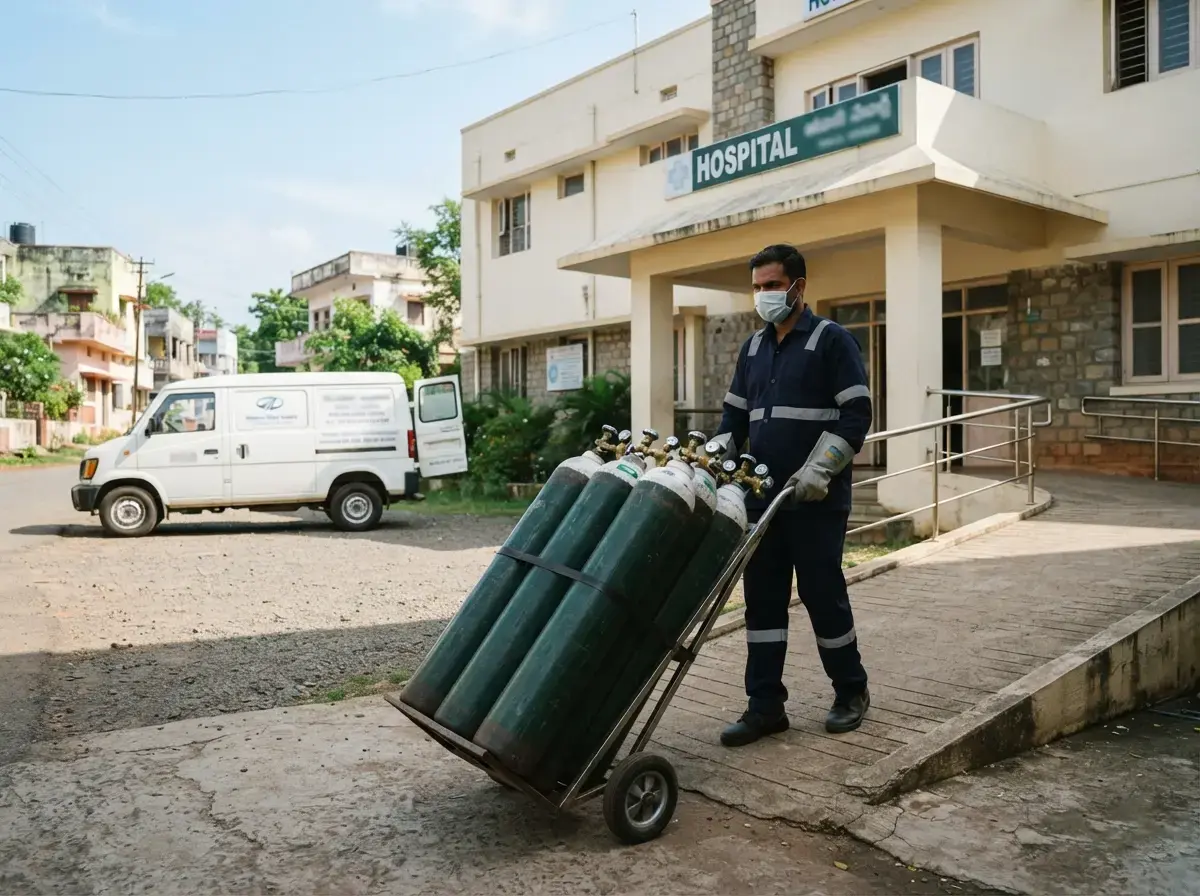
Prem Gas Solutions in Khagaria supplies medical oxygen to hospitals, clinics and nursing homes across Khagaria, Begusarai, Munger, Saharsa, Katihar and surrounding districts, with 24/7 emergency refill and delivery. Cylinders are available on refill, exchange, rental or purchase, and the team can help you work out a stocking plan sized to your bed count and area mix.
Your Next Step
Start this week: run the six-step worksheet with your own bed counts, compare the result with your current stock, and close the gap between the two. The hospital that knows its oxygen requirement before a crisis is the one that never has one. Call Prem Gas Solutions at +91 9470017017, message on WhatsApp, or use the contact form on the website to discuss your hospital's requirement, check cylinder availability, or arrange a regular delivery schedule.