
Gas Cylinder Accessories: Valves, Regulators, Keys, Hoses & Other Equipment

Gas Cylinder Accessories: The Essentials
A gas cylinder without accessories is just a sealed tank of high-pressure gas. The valve on top, the regulator that steps the pressure down, the key that opens it, and the hose that carries the gas to the work are the parts that turn a cylinder into a working tool, a welding station, or a home oxygen setup. Choose them wrong and you get leaks, wasted gas, and in the worst case, an accident. Choose them right and the cylinder serves you safely for years.
This guide walks through the gas cylinder accessories every setup needs: valves, regulators, keys, hoses, flowmeters, and safety gear. It also explains how to pick the right one for medical oxygen, welding, and industrial work. If you are buying for a workshop or for home oxygen care, this is the checklist to carry with you.
Before gas reaches you, keep these fittings and extras on hand:
- The cylinder valve is the tap on top of the cylinder that opens and closes the flow of gas.
- The pressure regulator brings the high cylinder pressure down to the working pressure your equipment needs.
- The cylinder valve key is the tool used to open and close valves that do not have a hand wheel.
- Hose or tubing carries the regulated gas to the torch, tool, or mask.
- The safety cap and other guards protect the valve during transport and storage.
- A cylinder trolley or stand moves and holds cylinders upright and secure.
Most of these parts are available together as gas cylinder hardware and accessories in Khagaria from Prem Gas Solutions, which makes it easier to match parts than to mix brands blindly. The sections below cover each item in detail, starting with the part that does the most important job.
Pressure Regulators: The Heart of the Setup
Gas leaves a full cylinder at high pressure. For oxygen and nitrogen, that is roughly 150 kg/cm², while CO2 and LPG cylinders fill at far lower pressures. Tools, torches, and medical equipment operate at a fraction of that. The regulator reduces the pressure to a safe, usable level and keeps it steady as the cylinder empties.
Regulators come in two main types:
- Single-stage regulators use one pressure-reducing stage. They are lighter, simpler, and fine for most workshop and general use, though output pressure drifts slightly as the cylinder empties.
- Double-stage regulators hold output pressure steady even when the cylinder is nearly empty. They are the right choice for precision welding and for any job where a constant flame matters.
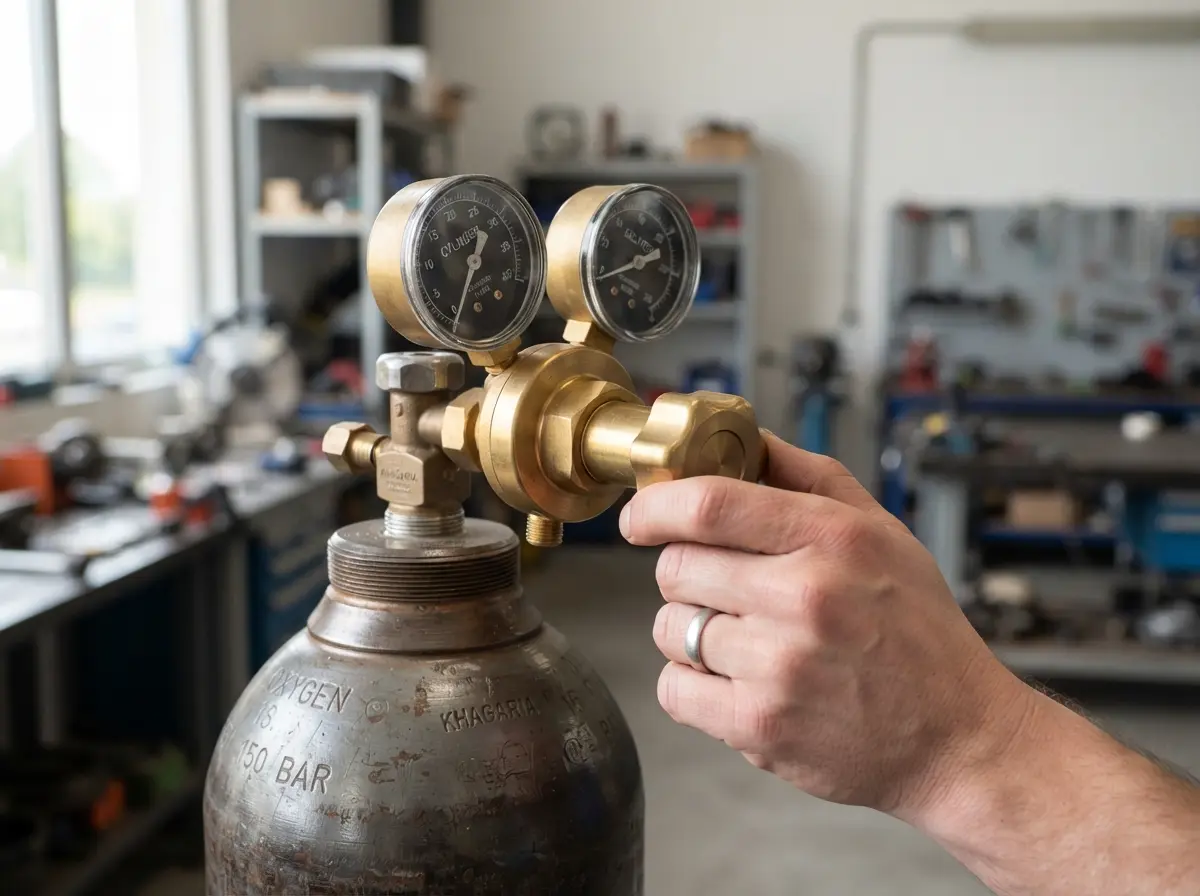
Two rules matter more than the stage type. First, a regulator is matched to a specific gas. A unit built for oxygen, argon, CO2, or LPG may have different threads, seats, and materials, so never assume one fits another. Second, never use an industrial regulator on a medical oxygen cylinder. Medical cylinders use pin-index fittings that physically prevent the wrong attachment, and the parts themselves are built to different standards. The difference between medical and industrial oxygen matters enough to read separately: our guide to medical oxygen vs industrial oxygen explains why the two must never be mixed.
When fitting a regulator, thread it by hand first, then snug it up with a spanner. If you have to force it, the threads are wrong. A forced fit is how gas leaks start.
Cylinder Valves and Keys
The valve is the tap on top of the cylinder. You open it to start the flow and close it to stop. Valves are built to the IS 3196 standard, with a brass body rated for high pressure. The connections vary by gas: oxygen fittings use right-hand threads, while fuel gas fittings such as acetylene and LPG use left-hand threads, often with a notch to tell them apart. Medical oxygen cylinders typically use pin-index fittings on the valve outlet.
The cylinder valve key is the tool that operates the valve when there is no hand wheel. Common styles include:
- Box-spanner keys, the traditional key that fits over the valve spindle.
- T-handle keys, which are easier to grip and turn, especially on stiff valves.
- Multi-head keys, which fit several valve types and suit workshops that run mixed cylinders.
Keep the key with the cylinder, not in a drawer. The moment you need to close a valve in a hurry, during a leak or an equipment failure, is not the time to hunt for a spanner. On medical cylinders that use hand wheels, no key is needed, but the valve still deserves a regular check for stiffness and leaks.
The Medical Oxygen Chain: Flowmeter, Humidifier, Tubing, Mask
Home oxygen therapy is a chain of components, and every link matters: cylinder, regulator, flowmeter, humidifier, tubing, and nasal cannula or mask. Medical oxygen cylinders come in different sizes for different needs. B-type is a compact size often used for home oxygen, D-type and E-type are larger portable cylinders, and jumbo cylinders handle bulk supply.
- The medical oxygen flowmeter measures and delivers oxygen at a set rate, typically 0 to 15 LPM, with a barb outlet for the tubing. Home oxygen usually runs at 1 to 5 LPM through a cannula.
- The humidifier bottle adds moisture to the oxygen before it reaches the patient, which keeps the airways from drying out during longer sessions.
- Oxygen tubing, nasal cannulas, and masks deliver the gas to the patient. Cannulas suit low-flow use; masks cover the nose and mouth when a higher concentration is needed.
- Nebulizer kits turn liquid medication into a fine mist for inhalation, usually run at 6 to 8 LPM.
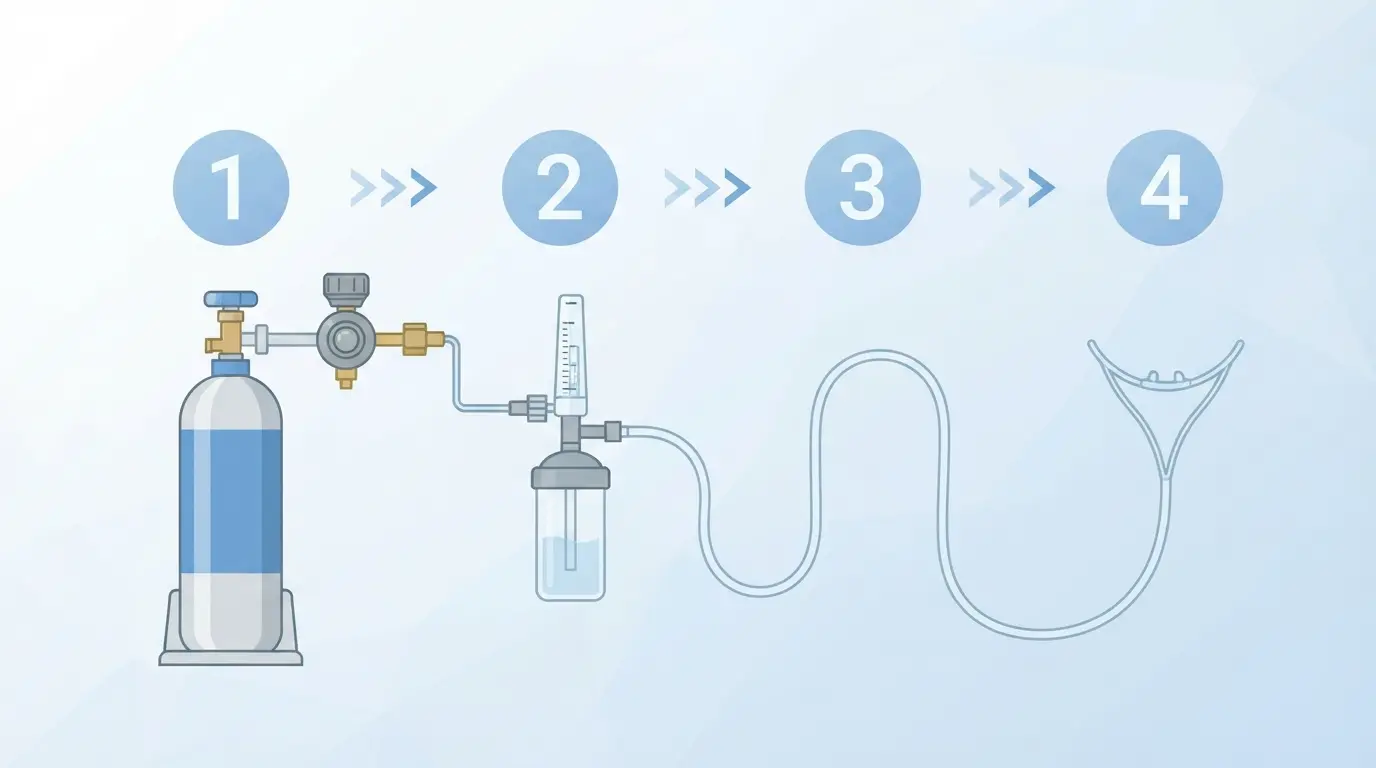
One point above everything else: the flow rate is set by the treating doctor, not chosen at home. A flowmeter shows the rate; it never decides it. This is general equipment guidance, not medical advice, so always follow a qualified healthcare professional's instructions. If you also want to understand what a cylinder itself costs, our post on the medical oxygen cylinder price in India covers the ranges. Prem Gas Solutions supplies medical oxygen cylinders in Khagaria with matching flowmeter, humidifier, and cannula setups.
Industrial and Welding Accessories: Hoses, Arrestors, Torches
For welding and fabrication, the cylinder is only half the setup. The working end needs hoses, a torch, and the safety fittings in between.
- Gas hose pipes are built to IS 3933 and colour-coded: red for fuel gas, black for oxygen. Never interchange them. A hose carrying the wrong gas is a hazard, not a convenience. Twin hoses carry both gases to the torch.
- Flashback arrestors fit between the hose and the regulator or torch. They contain a non-return valve and a flame trap that stop a flame from travelling back up the hose into the cylinder. Welding suppliers sell these as a set for a reason: this is the part that prevents the worst-case accident.
- Welding torches, nozzles, tips, and mixers are the working end that mixes the gases and shapes the flame. Keep the tips matched to the gas and the job.
- Pressure gauges show cylinder and working pressure. Replacement gauges, O-rings, washers, and Teflon tape for sealing are the common spare parts.
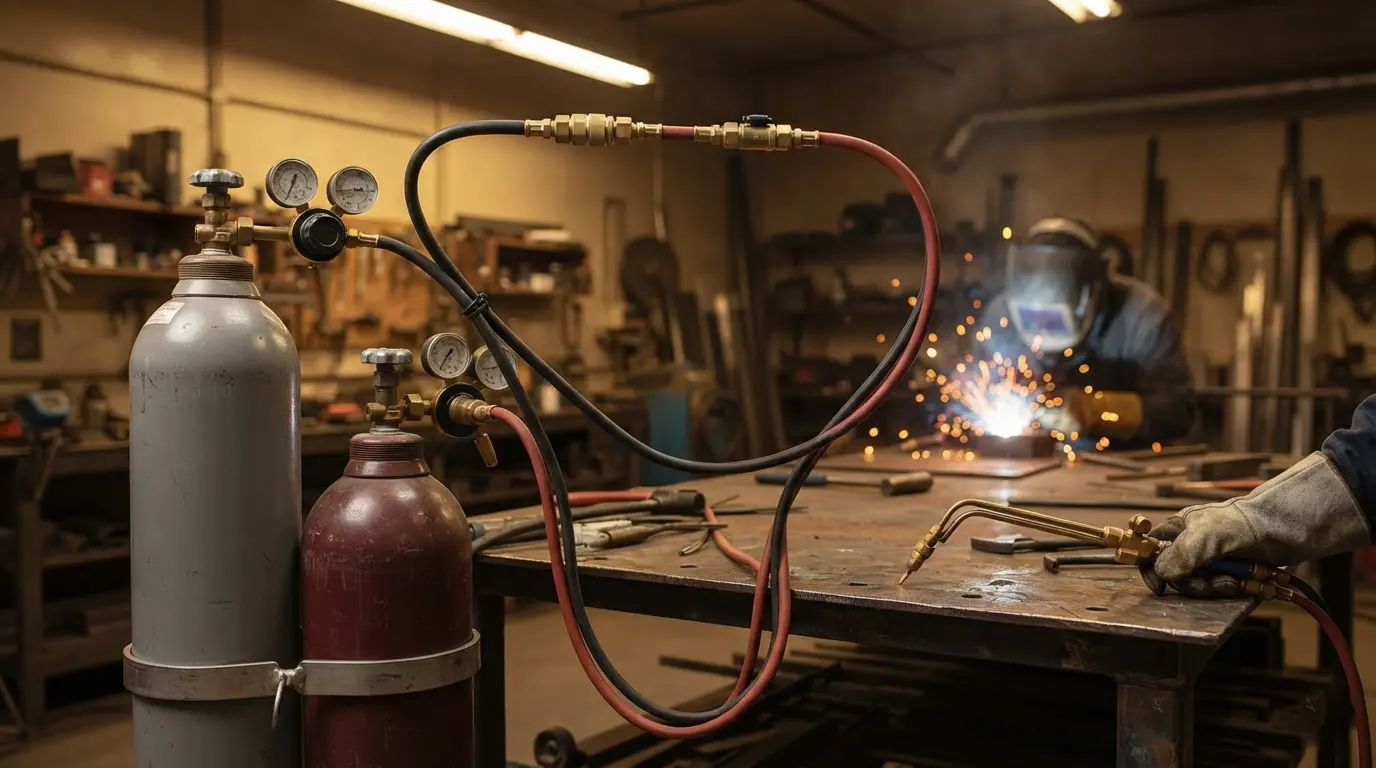
If an existing welding setup is already giving trouble, such as frozen regulators, leaking hoses, or weak flames, that is a repair problem, not a buying problem. Our guide to common welding equipment problems walks through those fixes step by step.
Safety Accessories: Caps, Trolleys, Leak Detection
Safety gear is the part of the accessories list people skip, and it is the part that protects the cylinder itself.
- Cylinder safety caps screw over the valve to protect it during transport. A knocked valve on a full cylinder is how serious accidents happen, so fit the cap whenever the cylinder moves.
- Cylinder trolleys come in single, double, and heavy-duty versions, with a safety chain. Never drag a cylinder; roll it on a trolley, chained in place.
- Chains, straps, and stands keep cylinders upright and secured against falling, both in storage and at the work site.
- Leak detection solution finds leaks at joints. The rule is simple: bubble-test every joint before use. Bubbles mean a leak, and a naked flame is never an acceptable way to find one.
- Fire extinguishers, gloves, and goggles are the last line of defence for the person doing the work.
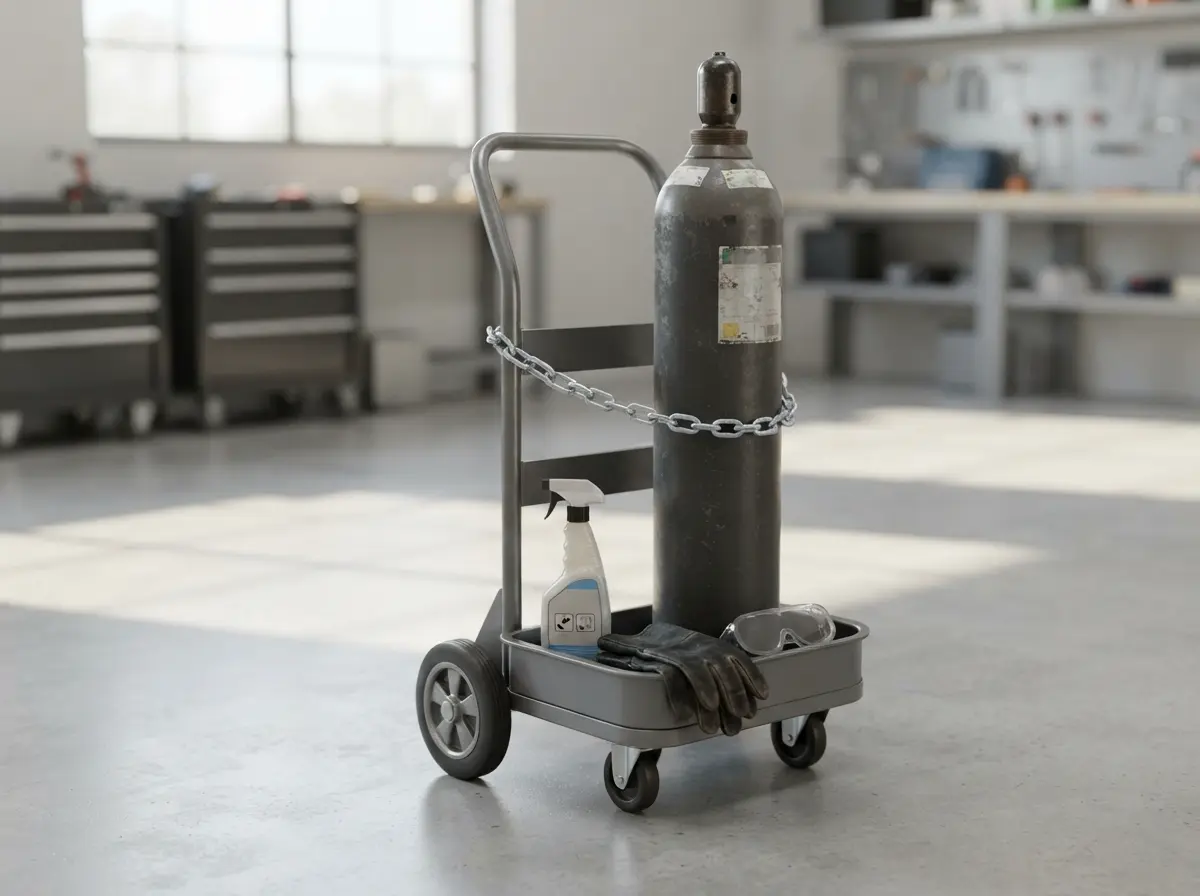
A short list of habits can prevent most cylinder accidents. Never grease or oil oxygen fittings, because oxygen and oil react violently under pressure. Close the valve when work stops. Keep cylinders upright and capped, and store them away from heat and open flame. Gas cylinder safety comes from these small, repeatable habits more than from any single piece of equipment.
Gas Cylinder Accessories: A Quick Buyer's Checklist
When you are ready to buy, run through this checklist instead of picking parts one at a time:
- Name the gas first. The regulator, hose, and fittings must match that specific gas.
- Separate medical from industrial. Medical oxygen typically uses pin-index fittings and medical-grade parts; industrial setups use their own threads. Never cross them.
- Check the cylinder size and valve type. The key and the regulator must match the valve on your cylinder, whether B-type, D-type, E-type, or a jumbo industrial size.
- List the chain, not just the regulator. For home oxygen, that is flowmeter, humidifier, tubing, and cannula. For welding, hoses, arrestors, torch, and tips.
- Add the safety extras from the start: cap, trolley, leak solution, and chain.
- Get a quote, not a guess. Accessories vary with the cylinder type and the gas. Contact Prem Gas Solutions at 9470017017 for current availability and pricing, or browse the range of cylinder valves, regulators and hoses in Khagaria online.
A cylinder is a strong, reliable container. The accessories are what make it useful, and the right accessories are what make it safe. Buy them as a matched set, check every joint, and keep the valve key close. That is the difference between a gas cylinder that works and one that works safely, year after year.