
Medical Oxygen Gas Devices & Accessories, Types, Uses, Safety & How to Use Them

When a patient needs supplemental oxygen at home or in a hospital, having the right medical oxygen gas devices and accessories is not optional — it is essential. A medical oxygen cylinder by itself is not enough. You need regulators, flow meters, masks, tubing, humidifiers, and several other accessories to deliver oxygen safely and effectively to the patient.
If you are a patient, an attendant, a hospital administrator, or a home-care provider in India, understanding medical oxygen equipment helps you make better purchasing decisions, use equipment correctly, and avoid safety risks.
This guide covers every major medical oxygen device and accessory — what each one does, how it works, what types are available, how to use it, and what mistakes to avoid.
What Are Medical Oxygen Devices and Accessories?
Medical oxygen devices and accessories are the components and tools used alongside a medical oxygen cylinder to store, control, deliver, and monitor oxygen for patient use. They include everything from the regulator that controls cylinder pressure to the mask or nasal cannula that delivers oxygen to the patient's airway.
These accessories can be grouped into three categories:
- Cylinder-side equipment — attached directly to the oxygen cylinder (regulator, flow meter, cylinder key, valve protection cap)
- Delivery equipment — carries oxygen from the cylinder to the patient (tubing, humidifier bottle, masks, nasal cannulas)
- Handling and safety equipment — supports safe storage, transport, and use (cylinder trolley, safety caps, stand)
Some devices, like pulse oximeters and oxygen concentrators, are complementary or alternative devices rather than cylinder accessories. We will cover those separately. For a broader look at cylinder accessories across industrial and medical applications, see our comprehensive guide to gas cylinder accessories.
Oxygen Cylinder — The Foundation of Medical Oxygen Supply
The medical oxygen cylinder is a high-pressure container that stores oxygen in compressed form. It is the starting point of every oxygen delivery setup.
Types of Medical Oxygen Cylinders
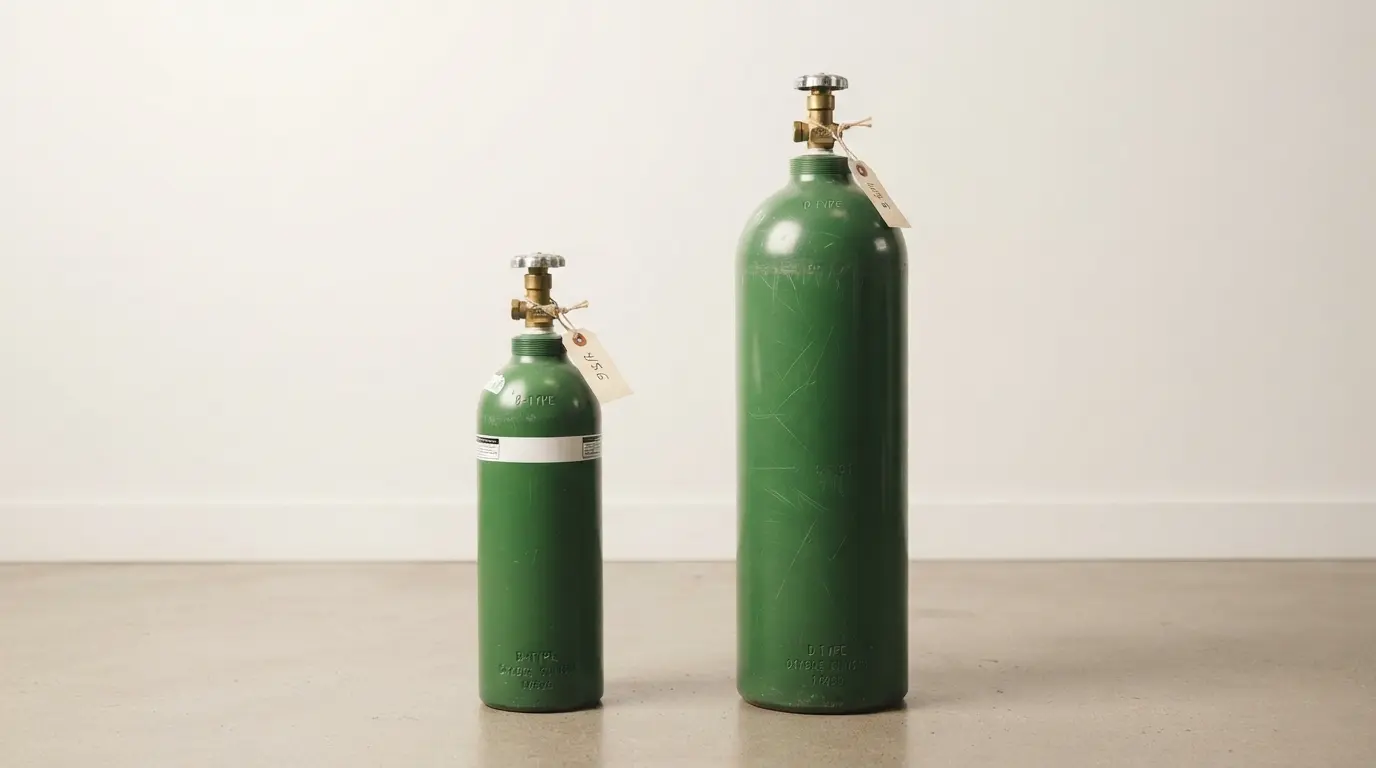
| Cylinder Type | Typical Capacity | Common Use |
|---|---|---|
| B Type | ~10 litres water capacity, ~1,500 litres gas | Home care, small clinics |
| D Type | ~46.7 litres water capacity, ~7,000 litres gas | Hospitals, larger clinics |
| Jumbo Cylinders | 40+ litres water capacity | Hospital piped systems, bulk use |
What to Know
- Medical oxygen cylinders are filled to approximately 150 bar (150 times atmospheric pressure). At this pressure, a B-type cylinder holds roughly 1,500 litres of oxygen and a D-type holds roughly 7,000 litres.
- Each cylinder has a valve at the top that controls gas release.
- Cylinders are colour-coded (in India, medical oxygen cylinders typically have a white body with a black shoulder, though markings vary).
- Only cylinders designed and tested for medical oxygen should be used for patient care.
⚠ COMMON MISTAKES
Using an industrial oxygen cylinder for medical purposes without verifying suitability is dangerous. Always check the pressure gauge before use, and never lay a cylinder on its side without proper support.
For pricing and availability details, see our guide on medical oxygen cylinder prices in India.
Oxygen Cylinder Regulator — Controlling Pressure
An oxygen regulator reduces the high pressure inside the cylinder to a lower, safe, and usable pressure. Without a regulator, the full cylinder pressure would be far too high and dangerous for patient delivery.
What a Regulator Does
- Reduces cylinder pressure (e.g., from 150 bar) to a working pressure (e.g., 4–6 bar).
- Provides a connection point for tubing and accessories.
- Many regulators include a flow meter to control the oxygen delivery rate.
Types of Regulators
- Single-stage regulators — reduce pressure in one step. Simple, compact, and common for portable and home use.
- Dual-stage regulators — reduce pressure in two steps for more stable output, especially as cylinder pressure drops. Used in hospital and high-flow applications.
- Regulator with built-in flow meter — a combined unit that both reduces pressure and controls flow rate. Very common in India for medical oxygen.
Compatibility
Regulators must match the cylinder valve type. In India, B-type and D-type cylinders have different valve connections. A regulator designed for a B-type valve will not fit a D-type cylinder.
⚠ COMMON MISTAKES
Forcing a regulator onto an incompatible cylinder valve can cause damage and leaks. Always check for leaks after attaching the regulator, and avoid overtightening connections.
For a detailed guide on selecting regulators, see our article on choosing the right pressure regulator for medical oxygen.
Oxygen Flow Meter — Measuring and Controlling Flow
An oxygen flow meter controls and displays the rate at which oxygen is delivered to the patient. The flow rate is measured in Litres Per Minute (LPM).
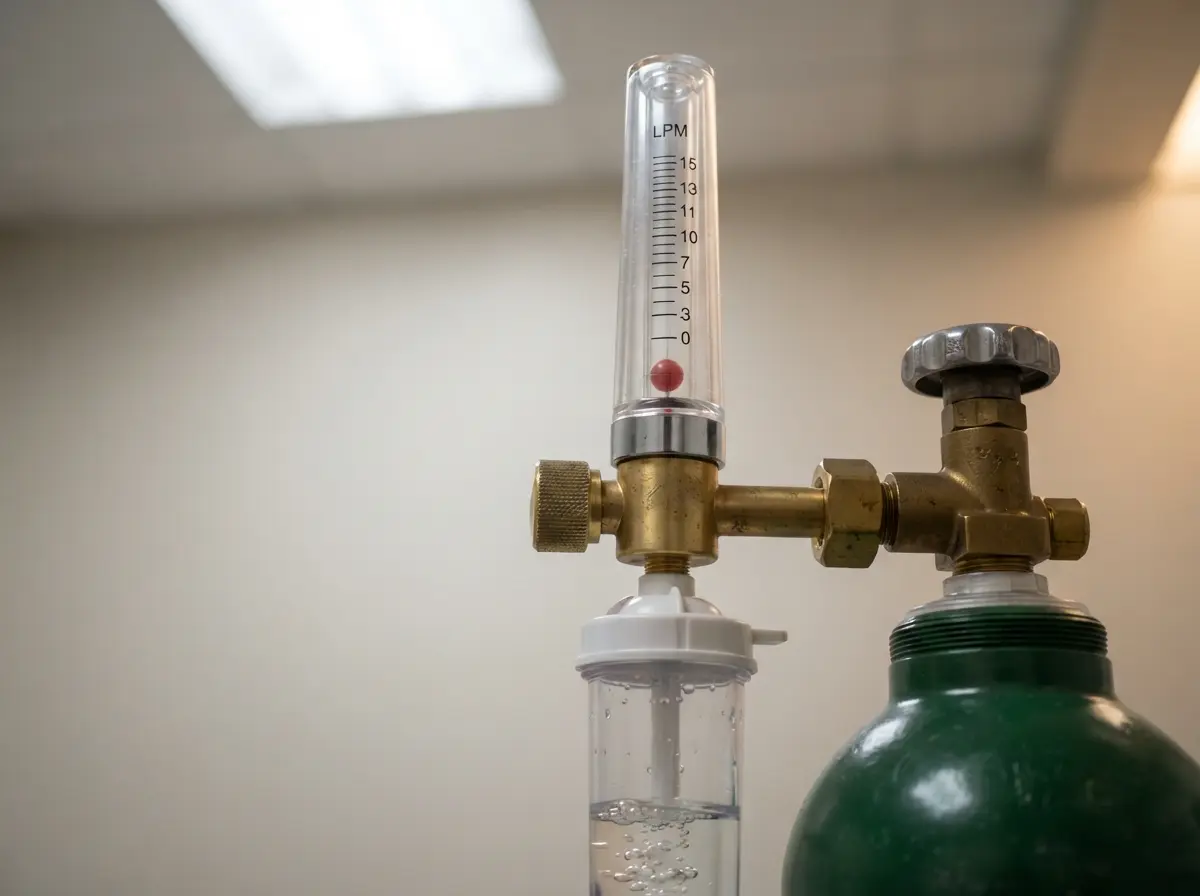
What LPM Means
LPM stands for Litres Per Minute. It tells you how many litres of oxygen flow to the patient every minute. For example, if a flow meter is set to 5 LPM, the patient receives 5 litres of oxygen per minute.
Types of Flow Meters
| Type | Description | Common Use |
|---|---|---|
| Fixed flow meter | Delivers one pre-set flow rate | Simple, single-patient setups |
| Adjustable flow meter | Allows the user to select the desired flow rate within a range | Most common for home and hospital use |
| Pressure-compensated flow meter | Provides accurate flow regardless of downstream resistance | High-accuracy clinical applications |
Common Flow-Rate Ranges
Typical adjustable flow meters cover ranges from 0.5 LPM to 15 LPM or higher. The exact range depends on the model and manufacturer.
⚠ SAFETY WARNING
Never change the oxygen flow rate without the treating clinician's instruction. The flow rate is part of the patient's prescribed treatment. Changing it without medical advice can be harmful. The information provided here is for understanding the equipment, not for self-adjusting treatment.
How to Check for Leaks Safely
After connecting the regulator and flow meter:
- Close the flow meter (set to zero).
- Open the cylinder valve.
- Apply a leak detection solution (or soapy water) to all connections.
- Watch for bubbles — bubbles indicate a leak.
- If you see bubbles, close the cylinder valve, tighten the connection, and recheck.
- If the leak persists, do not use the equipment. Contact your supplier.
Oxygen Mask — Types and Uses
An oxygen mask is a device placed over the patient's nose and mouth to deliver oxygen. Different mask types suit different clinical needs.
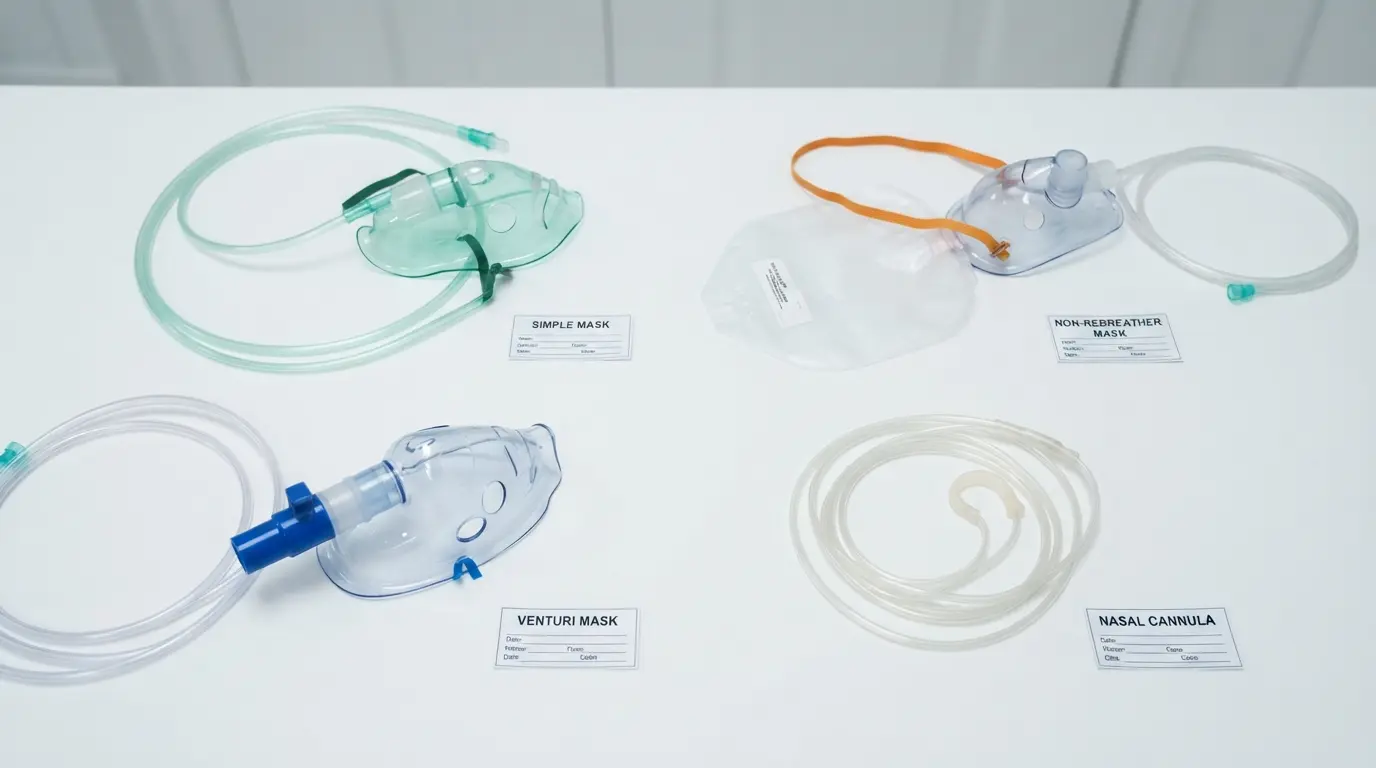
Simple Oxygen Mask
- Covers the nose and mouth.
- Delivers a moderate concentration of oxygen (approximately 35–60%, depending on flow rate).
- Suitable for patients who need more oxygen than a nasal cannula provides but do not need very high concentrations.
- Typical use: general oxygen supplementation in hospitals and clinics.
Non-Rebreather Mask
- Has a reservoir bag attached.
- Delivers high-concentration oxygen (up to approximately 90–100% at adequate flow rates).
- Designed so the patient inhales mostly oxygen from the reservoir bag, with minimal room air mixing.
- Typical use: emergency situations, patients with significantly low blood oxygen levels.
⚠ IMPORTANT
Non-rebreather masks must be used under medical supervision. They deliver very high oxygen concentrations and are not suitable for unsupervised home use without clinical guidance.
Venturi Mask
- Uses a Venturi valve to deliver a precise, controlled concentration of oxygen.
- Different coloured valves indicate different oxygen percentages (colours are manufacturer-specific).
- Useful when a specific oxygen concentration is required.
- Typical use: patients requiring controlled oxygen therapy (e.g., COPD patients where exact concentration matters).
Nasal Cannula
Covered in detail in the next section. A nasal cannula is technically not a "mask" but is a primary oxygen delivery interface.
Choosing the Right Mask
The choice of mask depends on the patient's condition, required oxygen concentration, and flow rate as prescribed by the doctor. Do not select a mask type based on personal preference.
Nasal Cannula — Comfortable Oxygen Delivery
A nasal cannula is a lightweight tube with two small prongs that sit inside the patient's nostrils. It delivers oxygen directly into the nasal passage.
Advantages
- More comfortable than a mask for long-term use.
- Allows the patient to eat, drink, and talk while receiving oxygen.
- Less claustrophobic than masks.
- Suitable for low to moderate flow rates.
Typical Use
- Home oxygen therapy.
- Patients requiring continuous but moderate oxygen supplementation.
- Patients who cannot tolerate a face mask.
Limitations
- Not suitable for very high oxygen concentrations.
- Oxygen delivery can be affected if the patient breathes through the mouth.
- Prongs can cause nasal dryness or irritation at higher flow rates.
💡 TIPS FOR USE
Ensure the prongs are correctly positioned inside the nostrils. Secure the tubing behind the ears and under the chin. Replace cannulas regularly — they can become stiff or clogged over time. Keep the prongs clean.
Oxygen Humidifier Bottle — Moisture for Comfort
When oxygen flows from a cylinder at high flow rates, it can be very dry. A humidifier bottle adds moisture to the oxygen before it reaches the patient, reducing dryness in the nose, throat, and airways.
How It Works
- The humidifier bottle is filled with sterile or distilled water (as recommended by the manufacturer or healthcare provider).
- Oxygen from the regulator/flow meter passes through the water.
- The oxygen picks up moisture.
- The humidified oxygen then flows through the tubing to the mask or cannula.
When Is a Humidifier Needed?
- When the patient uses oxygen at higher flow rates for extended periods.
- When the patient experiences nasal dryness, sore throat, or discomfort.
- When prescribed by the healthcare provider.
ℹ️ IMPORTANT NOTES
Use only sterile or distilled water — never tap water. Do not overfill the bottle — follow the manufacturer's fill line. Clean the humidifier bottle regularly to prevent contamination. Replace water daily or as recommended.
Oxygen Tubing — Connecting the System
Oxygen tubing is the flexible, transparent tube that carries oxygen from the humidifier or flow meter to the mask or nasal cannula.
Key Specifications
| Feature | Detail |
|---|---|
| Length | Typically 1.5 metres to 10+ metres (longer tubing for home setups) |
| Diameter | Standard bore (suitable for low to moderate flows) |
| Material | Medical-grade PVC or silicone (flexible, kink-resistant) |
| Connectors | Standard connectors that fit flow meters, humidifiers, masks, and cannulas |
💡 TIPS
Avoid kinking or bending the tubing sharply — this restricts flow. Keep tubing away from heat sources. Replace tubing if it becomes yellowed, stiff, or cracked. Use the appropriate length — excessively long tubing can reduce flow at the patient end.
Oxygen Cylinder Key / Spanner — Safe Operation
An oxygen cylinder key (also called a cylinder spanner or valve key) is a tool used to open and close the valve on an oxygen cylinder.
Why It Is Needed
The cylinder valve is operated by a handwheel or stem. The key provides the leverage needed to open and close the valve smoothly and safely.
Types
- Standard cylinder key — fits most common medical oxygen cylinder valves.
- Adjustable spanner — can accommodate different valve sizes.
- Integrated key — some regulators have a built-in key or handle.
Correct Use
Set flow meter to zero
Ensure the flow meter is set to zero before opening the cylinder.
Insert key into valve stem
Insert the key into the valve stem and turn slowly and steadily.
Open fully, then back off
Open fully, then back off slightly (half a turn) to prevent the valve from seizing.
Close gently
To close, turn clockwise gently until snug — do not overtighten.
⚠ CRITICAL SAFETY
Never use excessive force. If the valve does not turn easily, stop and contact your supplier. Never attempt to repair or modify a cylinder valve. Valve damage can cause dangerous leaks. Always close the cylinder when not in use.
Cylinder Trolley / Stand — Safe Handling and Transport
A cylinder trolley or stand is a metal frame on wheels or a static stand designed to hold an oxygen cylinder securely in an upright position.
Why It Matters
- Oxygen cylinders are heavy (a filled D-type cylinder can weigh approximately 50–55 kg).
- A falling cylinder can cause serious injury or damage the valve, leading to a dangerous release of oxygen.
- A trolley makes it easy to move cylinders between rooms or within a facility.
Types
| Type | Description | Best For |
|---|---|---|
| Single-cylinder trolley | Holds one cylinder on wheels | Home care, small clinics |
| Double-cylinder trolley | Holds two cylinders | Hospitals, high-demand settings |
| Static stand | Holds one cylinder without wheels | Fixed installation beside a bed |
💡 TIPS
Always secure the cylinder to the trolley with the chain or strap provided. Never drag or roll a cylinder without a trolley. Ensure the trolley is on a flat, stable surface.
Oxygen Cylinder Valve and Accessories
The cylinder valve is the mechanism at the top of the cylinder that controls the release of oxygen. It is the most critical safety component on the cylinder.
Related Accessories
- Valve protection cap — a plastic or metal cap that screws over the valve when the cylinder is not in use. Protects the valve from damage during storage and transport.
- Safety seal — an indicator that shows whether the cylinder has been opened. If the seal is broken, verify the cylinder contents before use.
- Dip tube — an internal tube inside the cylinder that ensures gas is drawn from the bottom. Most medical cylinders are designed to deliver gas with the cylinder in the upright position.
⚠ NEVER DO THIS
Never attempt to open, repair, or modify a cylinder valve yourself. Never use a cylinder with a damaged, leaking, or corroded valve. Never force a valve that is stuck.
Other Medical Oxygen Devices and Accessories
Several devices work alongside or complement an oxygen cylinder setup. These are not directly attached to the cylinder but are commonly used in medical oxygen care.
Pulse Oximeter
A pulse oximeter is a small clip-on device, usually placed on the patient's fingertip. It measures blood oxygen saturation (SpO2) and pulse rate.
- Not an oxygen delivery device — it monitors oxygen levels.
- Helps caregivers and doctors assess whether the oxygen therapy is effective.
- Common in hospitals and increasingly used in home care.
- Recommended for patients on long-term oxygen therapy.
Oxygen Concentrator
An oxygen concentrator is an electrically powered device that takes room air, removes nitrogen, and delivers concentrated oxygen to the patient.
- An alternative to oxygen cylinders — does not require refilling.
- Suitable for patients who need continuous, long-term oxygen.
- Requires a power supply (mains electricity or backup battery).
- Not a cylinder accessory, but often discussed alongside cylinder-based systems.
Nebulizer
A nebulizer converts liquid medication into a fine mist for inhalation into the lungs. While not strictly an oxygen device, oxygen-driven nebulizers use oxygen flow from a cylinder (typically 6–8 LPM) to power the nebulizer.
- Used for delivering bronchodilators and other respiratory medications.
- Connects to the oxygen cylinder via standard tubing.
- Common in hospitals and clinics.
Other Accessories
- Oxygen mask straps and elastic bands — hold the mask in place.
- Nose pads for nasal cannulas — improve comfort.
- Oxygen cylinder storage rack — for storing multiple cylinders safely.
- Leak detection solution — for checking connections.
Medical Oxygen vs Industrial Oxygen
This is an important distinction that every user should understand.
Medical oxygen is oxygen produced, tested, and supplied specifically for patient use. It meets specific purity and quality standards. It is supplied through approved medical gas channels.
Industrial oxygen is oxygen produced for industrial applications such as welding, cutting, and manufacturing. It may not meet the purity or quality requirements for patient use.
| Aspect | Medical Oxygen | Industrial Oxygen |
|---|---|---|
| Purity | Meets medical-grade standards | May not meet medical purity standards |
| Moisture content | Controlled | Not controlled |
| Contamination risk | Low (tested for patient safety) | Higher (industrial use does not require medical-grade testing) |
| Supply channel | Medical gas supplier | Industrial gas supplier |
| Intended use | Patient respiratory support | Welding, cutting, manufacturing |
⚠ NEVER ASSUME
Never assume that any oxygen cylinder is suitable for medical use. Always source medical oxygen from a qualified medical gas supplier.
For more information, see our article on differences between medical and industrial oxygen.
How to Set Up Medical Oxygen — Step by Step
For hospitals planning oxygen infrastructure, see our guide on hospital oxygen cylinder requirements and calculation.
Oxygen Cylinder → Regulator/Flow Meter → Humidifier (if prescribed) → Tubing → Oxygen Mask or Nasal Cannula → Patient
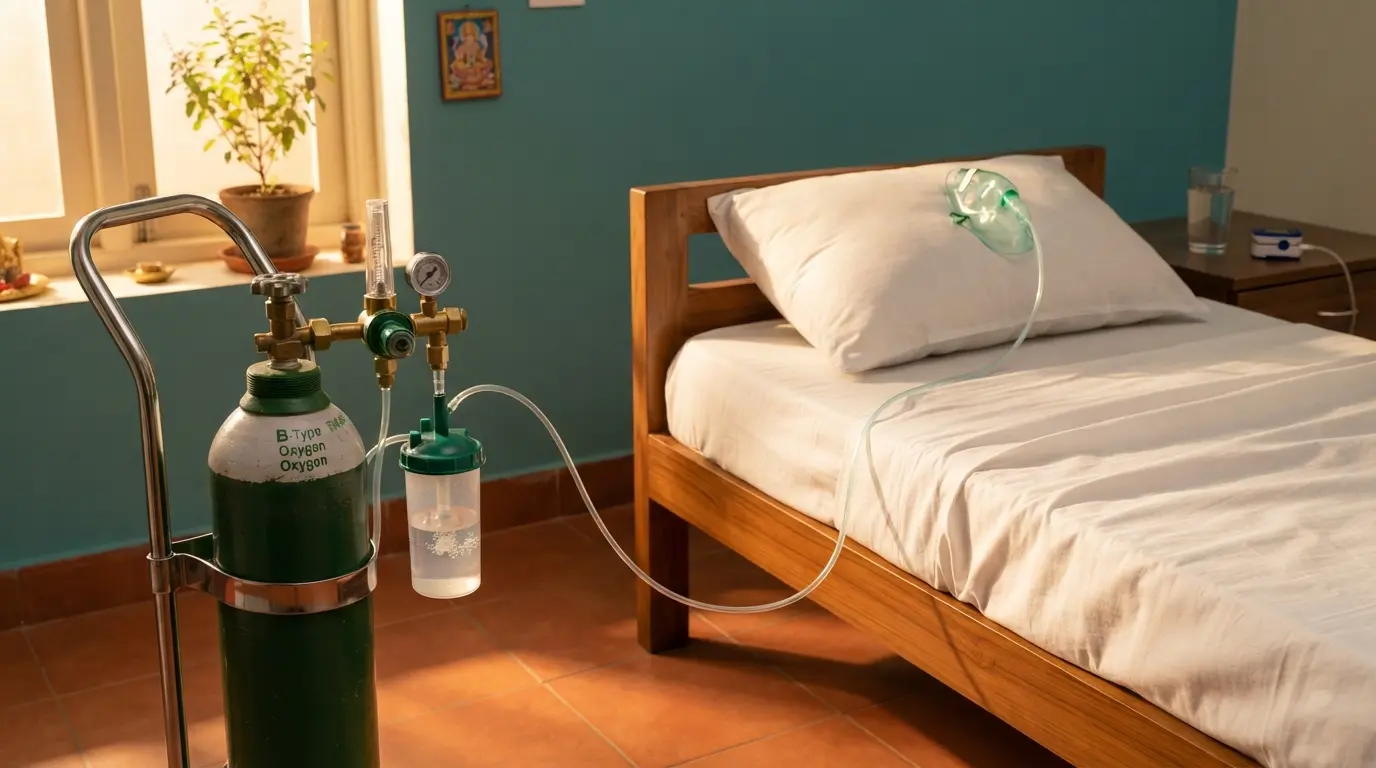
Secure the cylinder
Place the cylinder upright on a trolley or stand. Secure it with the chain or strap.
Attach the regulator
Attach the regulator to the cylinder valve. Ensure the connection is compatible and tight. Use the cylinder key if needed.
Check for leaks
Apply leak detection solution to all connections and watch for bubbles.
Set flow meter to zero
Ensure the flow meter is set to zero before opening the cylinder valve.
Open the cylinder valve
Open the cylinder valve slowly by turning the key counter-clockwise.
Connect the humidifier
Connect the humidifier (if prescribed) to the regulator outlet. Fill with sterile or distilled water to the marked level.
Connect tubing and mask
Connect the oxygen tubing from the humidifier outlet (or directly from the regulator if no humidifier is used). Connect the mask or nasal cannula to the other end.
Set flow rate and verify
Set the prescribed flow rate on the flow meter (only as directed by the treating clinician). Place the mask or cannula on the patient. Verify that the humidifier bubbles gently and the patient is receiving oxygen.
⚠ WHAT TO AVOID
Do not attempt to refill, transfer, or modify cylinders yourself. Do not use adapters or fittings that are not designed for medical oxygen equipment. Do not leave a running oxygen setup unattended without proper monitoring.
How to Choose the Right Medical Oxygen Equipment — Buyer's Checklist
When purchasing medical oxygen equipment, use this checklist to make sure you get what you need:
☑ Medical Oxygen Equipment Buyer's Checklist
ℹ️ WHY PRICE SHOULD NOT BE THE ONLY FACTOR
The cheapest regulator, mask, or accessory may not be the safest or most reliable. Medical oxygen equipment directly affects patient health. A poorly made regulator may leak, an ill-fitting mask may reduce oxygen delivery, and low-quality tubing may crack. Invest in equipment that is designed for medical oxygen use and sourced from a trusted supplier.
Common Problems & Troubleshooting
| Problem | Possible Cause | What to Do |
|---|---|---|
| No oxygen flow | Cylinder valve closed; regulator not connected; tubing kinked | Check cylinder valve; verify regulator connection; straighten tubing |
| Low or unstable flow | Tubing kinked; humidifier water blocking flow; regulator malfunction | Check tubing; check humidifier water level; contact supplier |
| Regulator not working | Internal fault; damage | Stop using; contact your supplier or technician |
| Suspected leak | Loose connection; damaged seal; cracked tubing | Apply leak detection solution; tighten connections; replace damaged parts |
| Damaged tubing | Age, wear, or kinking | Replace tubing immediately |
| Mask discomfort | Wrong size; tight straps | Try a different mask size; adjust straps; try a nasal cannula |
| Empty cylinder | Cylinder depleted | Replace with a full cylinder; keep a spare cylinder available |
| Wrong connector/fitting | Incompatible equipment | Use only compatible connectors; do not force-fit |
⚠ SAFETY-CRITICAL
For any safety-critical problem — such as a suspected gas leak, damaged valve, regulator malfunction, or any situation you are unsure about — stop using the equipment immediately and contact a qualified supplier, technician, or healthcare professional. Do not attempt repairs yourself.
Medical Oxygen Safety: Important Things to Remember
Medical oxygen is a medical gas. It supports combustion (makes fires burn faster and hotter) and is used as a medicine. Safe handling is critical.
Fire and Heat Safety
- Keep oxygen away from flames, smoking, sparks, and heat sources. No smoking near oxygen equipment. Keep cylinders at least 5 metres from any open flame.
- Do not use oil, grease, or petroleum-based products on oxygen equipment. Oxygen and grease can cause spontaneous combustion.
- Keep oxygen away from combustible materials. Oxygen enriches combustion — even materials that normally do not burn can catch fire more easily in an oxygen-rich environment.
Equipment Handling
- Keep cylinders upright and properly secured. Use a trolley, stand, or chain. A falling cylinder can damage the valve and cause a dangerous gas release.
- Prevent cylinders from falling or rolling. Never lay a cylinder on its side without proper support.
- Open cylinder valves slowly. Rapid opening can cause pressure surges.
- Check connections and fittings. Verify all connections are tight before opening the cylinder.
- Check for leaks. Use leak detection solution. Never use a flame to check for leaks.
- Use only compatible and approved equipment. Do not mix equipment from different manufacturers unless confirmed compatible.
- Do not modify valves, regulators, or fittings. Modification can cause dangerous failures.
Cleanliness and Maintenance
- Keep oxygen equipment clean. Contamination can affect oxygen quality and patient safety.
- Avoid contamination of oxygen connections. Do not touch the inside of connectors or let them contact surfaces.
- Do not use damaged cylinders, regulators, masks, or tubing. Replace damaged equipment immediately.
Storage and Transport
- Store cylinders in a suitable, well-ventilated area. Avoid enclosed spaces where leaked oxygen could accumulate.
Compliance and Medical Guidance
- Follow cylinder markings, manufacturer's instructions, and applicable Indian regulations. Check the cylinder's test date and certification.
- Do not attempt cylinder filling, refilling, or gas transfer without appropriate authorization and facilities. Cylinder filling is a regulated activity that requires proper equipment and trained personnel.
- Keep oxygen equipment away from children unless supervised.
- Never change prescribed oxygen flow without medical advice. The flow rate is part of the patient's treatment plan.
⚠ MEDICAL OXYGEN IS A MEDICINE
Medical oxygen is a medicine and medical gas. It should be used according to medical advice and applicable requirements. Always follow the treating clinician's instructions and the equipment manufacturer's guidelines.
For more on oxygen safety practices, see our article on medical oxygen vs industrial oxygen safety.
For hospital-level oxygen planning and equipment requirements, see our hospital oxygen cylinder requirements guide.
Frequently Asked Questions
PREM GAS SOLUTIONS — Your Medical Oxygen Equipment Supplier
Need Medical Oxygen Equipment? Contact Prem Gas Solutions
Prem Gas Solutions is a medical and industrial gas supplier based in Khagaria, Bihar, serving hospitals, clinics, nursing homes, home-care users, and customers across Mansi, Gogri, Begusarai, and surrounding areas.
Chat on WhatsApp →Products Available
- Medical oxygen cylinders
- Oxygen regulators and flow meters
- Oxygen masks (simple, non-rebreather, Venturi)
- Nasal cannulas
- Oxygen cylinder keys and spanners
- Humidifier bottles
- Oxygen tubing
- Cylinder trolleys and stands
- Other medical oxygen accessories
Availability can be checked with Prem Gas Solutions. Contact for product specifications, pricing, and orders.
Get in Touch
- Phone: 9470017017
- WhatsApp: Chat on WhatsApp
- Email: info@pkgas.com
- Website: www.pkgas.com
- Product page: Gas cylinder hardware and accessories
Whether you are setting up oxygen at home, equipping a hospital ward, or need reliable accessories for your clinic, Prem Gas Solutions provides quality equipment backed by knowledgeable support. Contact them today to discuss your requirements.
🔑 Key Takeaway
Medical oxygen equipment is not one-size-fits-all. Every component — from the cylinder and regulator to the mask and tubing — plays a role in safe and effective oxygen delivery. Choose equipment that is compatible, intended for medical use, and sourced from a trusted supplier. Always follow your healthcare provider's instructions for setup and flow rates.
Disclaimer: This article is for educational and informational purposes only. It does not constitute medical advice. Always follow the treating clinician's instructions and the equipment manufacturer's guidelines for oxygen therapy. Medical oxygen is a medicine and should be used accordingly.