
Medical oxygen is oxygen produced, tested, and filled to pharmaceutical standards for breathing support, and in India it is regulated as a drug under the Drugs and Cosmetics Act. Industrial oxygen is made for welding, cutting, and manufacturing, and it can contain impurities that are harmless in a flame but dangerous to inhale. The medical oxygen vs industrial oxygen difference is not cosmetic: getting it wrong can save a life or cost one.
This guide covers what each gas is, how both are made and tested, purity standards, cylinder identification and color coding, storage and safety rules, uses, and pricing, plus the questions customers ask us most often at Prem Gas Solutions in Khagaria, where we supply both kinds of gas every day.
What Is Medical Oxygen?
Medical oxygen is oxygen intended for breathing support. In India it is manufactured, tested, stored, and supplied as a pharmaceutical product: every batch is accountable to quality standards the way a medicine is.
The World Health Organization defines medicinal oxygen as Oxygen 99.5% or Oxygen 93%. Oxygen 99.5% contains not less than 99.5% oxygen by volume, produced by cryogenic distillation of air; Oxygen 93% (90–96%) comes from pressure swing adsorption (PSA) plants. Both grades must meet strict limits for contaminants like carbon monoxide, carbon dioxide, moisture, and particulates.
In India, the Supreme Court confirmed in 2020 (State of Andhra Pradesh v. Linde India Ltd.) that medical oxygen is a drug. That classification is not cosmetic: manufacturing requires a drug licence from the state drug controller under CDSCO oversight, sale requires drug sale licences, the product must comply with the Indian Pharmacopoeia monographs for Oxygen, and licensed premises must be dedicated to it.
So medical oxygen is not just a gas but a regulated, documented, tested pharmaceutical, which is why a medical oxygen supplier treats it completely differently from welding gas.
What Is Industrial Oxygen?
Industrial oxygen is the same element produced on a much larger scale for industry. Its job is to support combustion, accelerate chemical reactions, and enrich processes, not to be breathed.
The bulk of oxygen manufactured in India is industrial grade, flowing to steel plants, fabrication shops, glass factories, chemical plants, and automobile workshops. The gas comes from the same method, air separation, but the quality controls and regulatory framework differ: industrial oxygen is not required to meet pharmacopoeial limits for carbon monoxide, moisture, or particulates, because nobody is supposed to inhale it. Its specification is written for industrial performance, not human safety.
That does not make industrial oxygen "bad." It is fit for purpose and does its job superbly in furnaces, torches, and reactors; it is simply built for a different job.
Is the Oxygen Molecule Different?
No. This is where a lot of confusion starts, so let us be direct: the oxygen molecule in a medical cylinder is identical to the one in an industrial cylinder, the same O2 whether it powers a hospital bed or a cutting torch.
The difference is not the molecule but everything around it: how the gas is produced and to what specification, what impurities are allowed to remain, how it is tested and documented, and which regulatory framework governs the supply chain.
Think of water. A glass from a drinking-water plant and a tank used for industrial cooling are both H2O. One is treated, tested, and certified for human consumption; the other is not. Nobody would argue that "water is water, so drink the coolant." Oxygen works the same way. The molecule is the same; the assurance around it is not.
Manufacturing Process
Both grades start with ordinary atmospheric air, roughly 21% oxygen, 78% nitrogen, and 1% argon and other gases, separated by two main technologies.
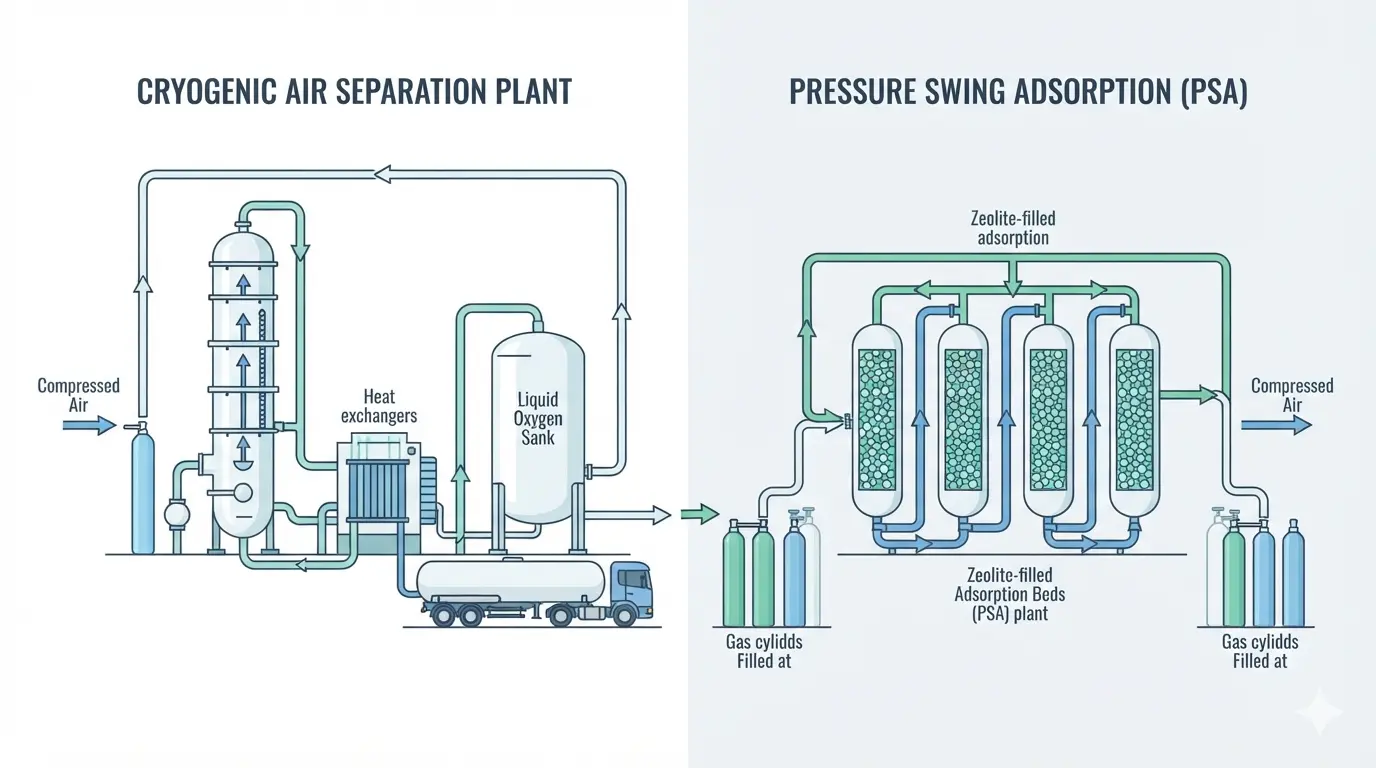
Cryogenic air separation compresses air, cools it to around minus 180°C, and liquefies it, then splits the gases by fractional distillation. It produces oxygen at 99.5% or better, and it is the standard method for liquid medical oxygen: large air separation units feed liquid oxygen into cryogenic tankers that deliver to hospitals and refilling plants.
Pressure swing adsorption (PSA) passes compressed air through zeolite beds that trap nitrogen and let oxygen flow through, producing around 93% purity. PSA plants became a common emergency supply route for hospitals during the pandemic. The WHO's International Pharmacopoeia recognizes an Oxygen 93% grade (90–96% v/v), with interim guidance setting 93% ± 3% as the minimum for PSA medical oxygen. Oxygen concentrators use a related process and typically deliver 90–96% oxygen from room air.
Once produced, oxygen is compressed into cylinders at high pressure, typically around 150 bar, or transported as liquid. From here, medical and industrial practice diverge.
Purity Standards
Medical oxygen purity is the cleanest way to see the difference, because the numbers are public and verifiable.
Medical oxygen must meet the WHO International Pharmacopoeia standard of Oxygen 99.5% for cryogenic production: not less than 99.5% oxygen by volume, with maximum limits for carbon dioxide (300 ppm), carbon monoxide (5 ppm), and water (67 ppm). The European Pharmacopoeia requires the same 99.5%, and the Indian Pharmacopoeia has its own Oxygen monographs that medical oxygen in India must comply with.
Industrial oxygen is also typically supplied at 99.5% or higher, which surprises many people, but the specification is performance-based: the critical difference is not the headline purity figure but what the standard requires to be tested and controlled. Industrial grades are not held to pharmacopoeial limits for carbon monoxide, carbon dioxide, moisture, oil, or particulate contamination, because those requirements exist to protect breathing, not to satisfy a flame.
This is the nuance that trips people up. "Both are 99.5% pure" sounds like proof they are identical. It is not. The medical standard certifies what is in the remaining 0.5%; the industrial standard does not guarantee it.
Quality Testing
Medical oxygen is tested as a drug, batch by batch. Manufacturers validate their production process, sample filled cylinders on a defined schedule, and test for identity, purity, and contaminants. Records are kept and certificates of analysis accompany supply. The WHO's good manufacturing practices for medicinal gases require every batch to be tested against the authorized specification before it reaches a patient.
Industrial oxygen is tested for the parameters that matter to industry, but there is no drug-licence chain of custody, no pharmacopoeial certificate of analysis, and no regulator watching it as a medicine.
A practical way to see the difference: ask a medical oxygen supplier for batch documentation. A licensed supplier can produce it; an industrial gas dealer cannot, because that paperwork does not exist for industrial product.
Cylinder Identification
Cylinders for medical and industrial oxygen are manufactured to similar high-pressure standards, but their identification and use are strictly separated.
In India, cylinder manufacture, filling, and periodic testing are governed by the Gas Cylinder Rules, 2016, administered by the Petroleum and Explosives Safety Organisation (PESO). Filling premises need licences, and every cylinder must carry the gas name, filling details, and the identification colors required by the standards.
Every cylinder also carries stamped details: manufacturer, serial number, water capacity, test pressure, and the date of the last periodic hydraulic test. An expired test makes a cylinder unsafe to fill, and a responsible supplier will refuse it. Medical oxygen cylinders come in standard sizes like the B Type (10-litre) and D Type jumbo (46.7-litre), and a medical oxygen cylinder is filled, inspected, and documented to drug standards.
Do not rely on appearance alone. During the 2020 oxygen crisis, PESO published standard operating procedures for converting industrial cylinders to medical use: cleaning, inspection, re-painting, re-labeling, and re-documentation under supervision. Even in an emergency, the authorities did not say "just swap the labels."
Color Coding
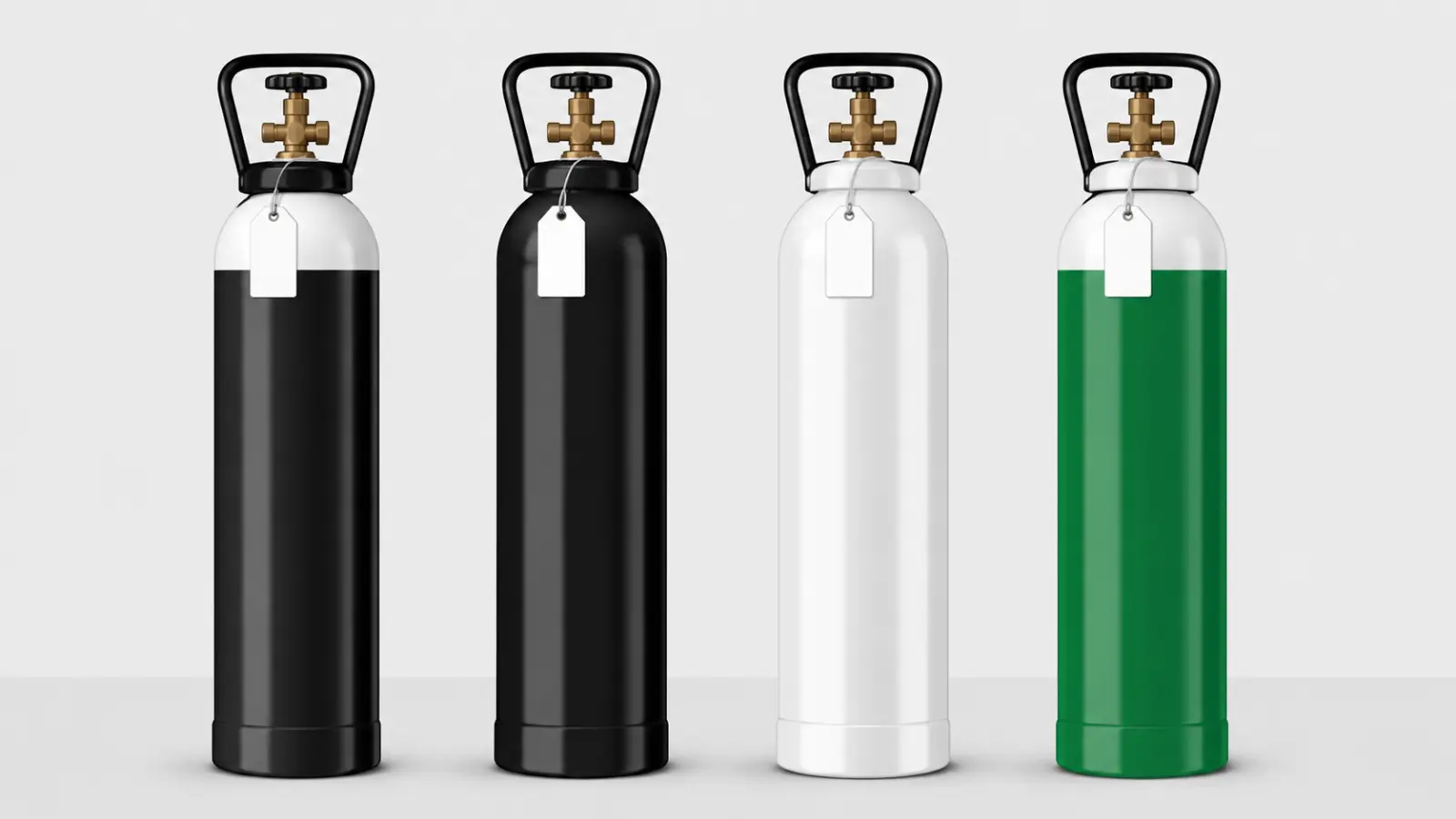
Color is a quick visual cue, but not proof of contents. Standards vary by country, by standard, and even by manufacturer, so always confirm the gas by reading the cylinder label and markings, never by color alone.
To see how much this varies:
- In India, medical oxygen cylinders are painted with a white shoulder and black body under IS 3933.
- Indian industrial oxygen cylinders under IS 4379 are typically black.
- The international standard ISO 32:1977 designates white for medical oxygen.
- In the United States, oxygen cylinders have historically been green with white tops, under different rules.
So a black cylinder in an Indian workshop is probably industrial oxygen, a black-bodied cylinder with a white shoulder should be medical oxygen, and in another country the same gas might be painted entirely differently. The label is the truth; the paint is just a hint.
Storage Requirements
Oxygen does not burn, but it makes everything else burn faster and hotter. That single fact drives every storage rule.
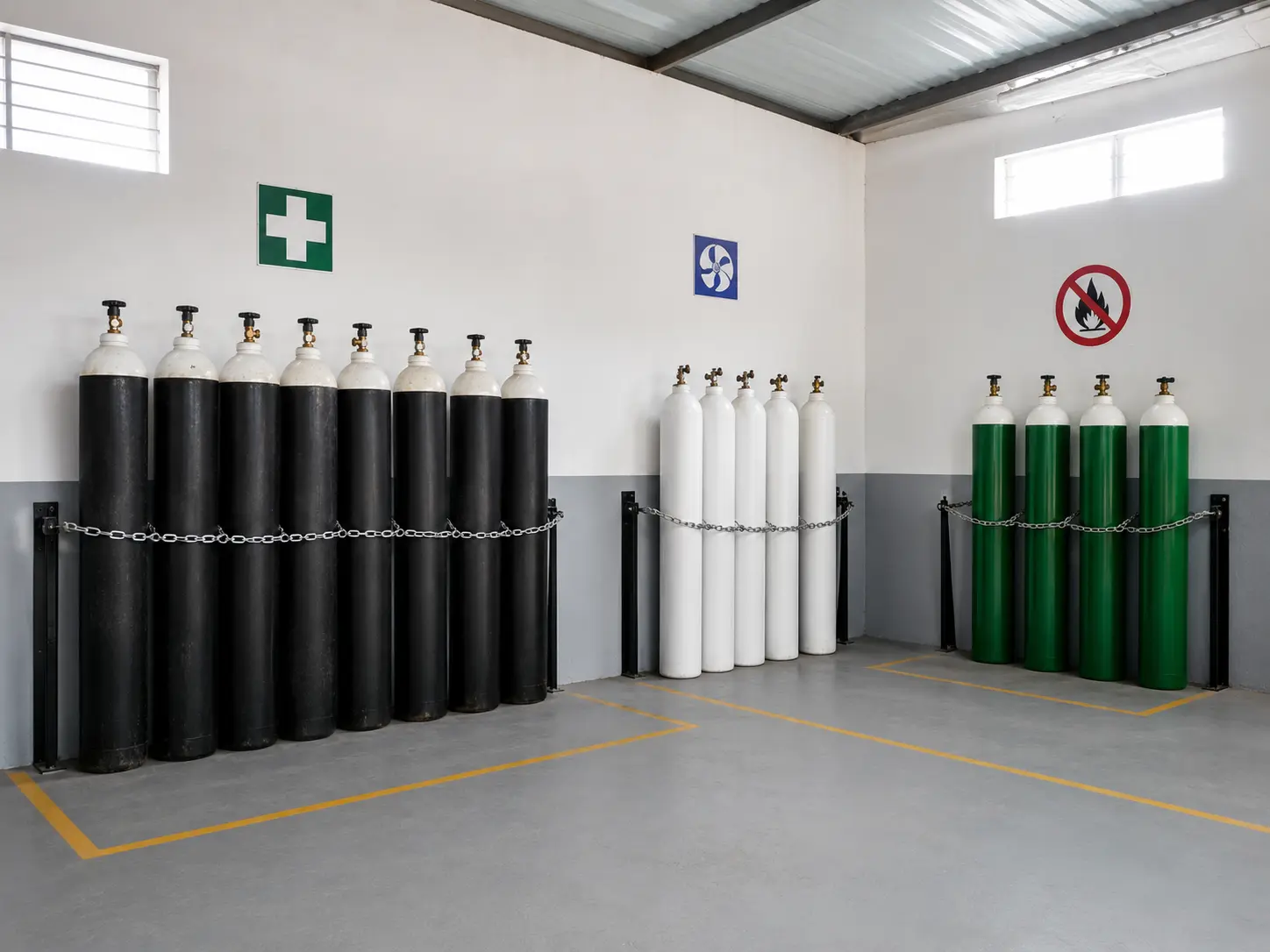
- Store cylinders upright and secured to a wall, rack, or trolley. A falling cylinder can shear its valve and become a projectile.
- Keep oxygen away from heat sources, direct sunlight, flames, stoves, and combustible materials.
- Keep full and empty cylinders in separate, labelled areas, away from flammable gases like acetylene or LPG.
- Keep medical and industrial cylinders apart so nobody grabs the wrong one in a hurry.
- Store in a ventilated, dry area, and keep valve caps fitted when not connected.
Hospitals, clinics, and workshops should all be able to answer one question: if a fire starts here, could anyone grab the wrong cylinder?
Safety Requirements
The medical oxygen safety rules and the industrial ones are the same, because the gas behaves the same way. The difference is the consequence of getting it wrong: a workshop loses a batch, a patient loses a life.
- No smoking near oxygen. Oxygen-enriched air makes materials burn far more readily; cigarettes, incense, mosquito coils, and pilot flames all become hazards.
- No oil or grease on fittings. This is the single most dangerous mistake. A greasy hand, an oily rag, or a lubricated thread on a high-pressure oxygen connection can ignite and fail catastrophically, because oxygen and petroleum products react with explosive violence. Use only oxygen-compatible materials, which is to say almost none.
- Open the valve slowly. A sudden blast of high-pressure gas through a regulator is how equipment fails. Crack it open gently, then open fully once flow is steady.
- Fit a regulator before opening the valve. Never open a valve to test or check pressure without one in place.
- Check the cylinder. Dents, corrosion, a damaged valve, or an expired test date means it goes for inspection, not use.
- No DIY refilling. Filling requires licensed equipment, trained staff, and inspection; an over-pressurised cylinder can burst.
- Know the gas. If the label is missing, unclear, or painted over, treat the cylinder as unknown and return it. Guessing is not an option with a high-pressure cylinder.
Oxygen is not flammable, but it feeds fire violently. Respect that, and it is a safe industrial tool and a life-saving medicine.
Common Industrial Uses
Industrial oxygen uses span almost every heavy process industry:
- Steel and iron production. Oxygen is blown into blast furnaces and converters to raise combustion temperatures and strip impurities.
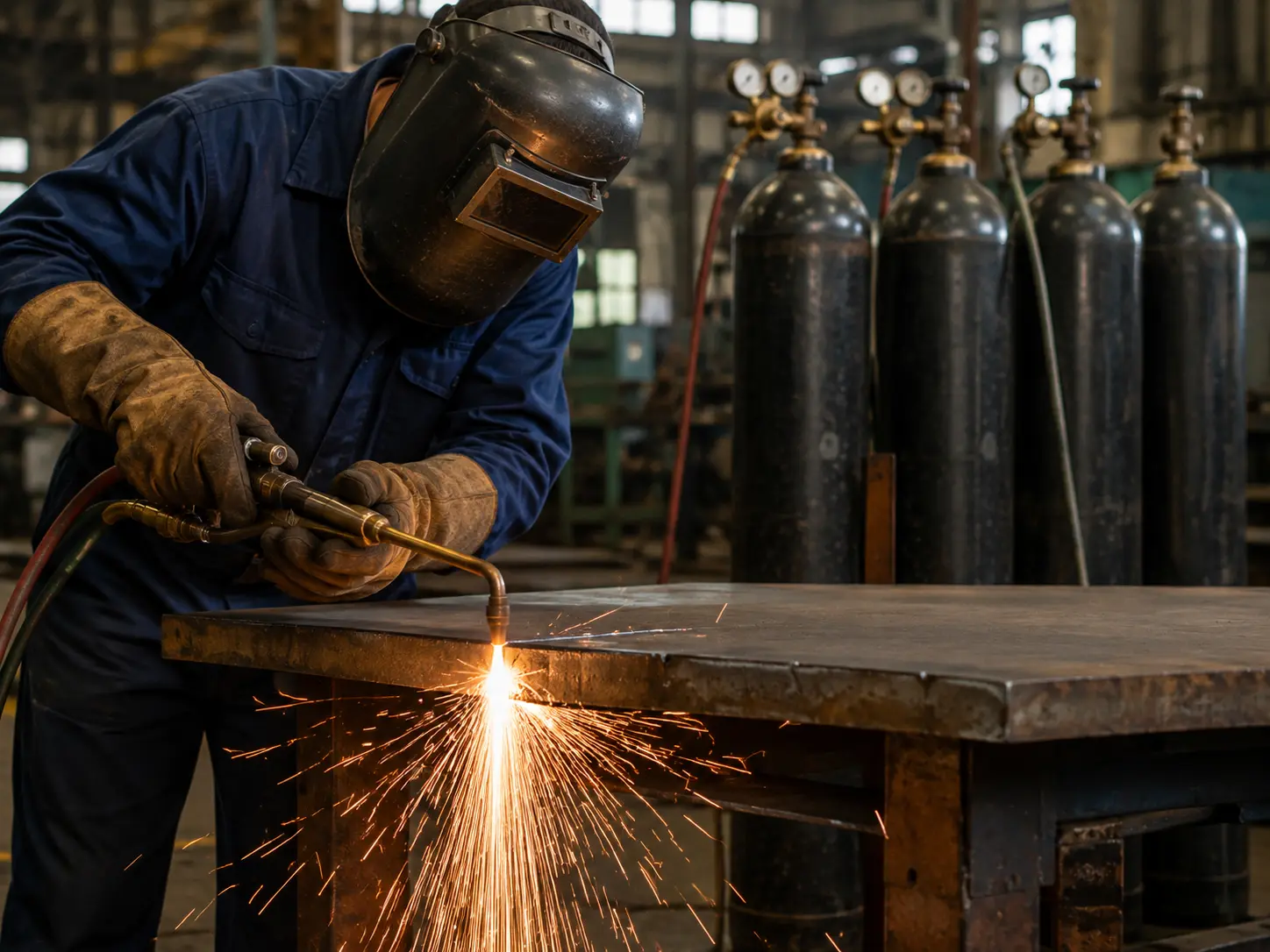
- Welding and cutting. Oxy-fuel torches combine oxygen with fuel gas for cutting and welding thick metal, the use most fabrication shops in Khagaria know well.
- Glass and ceramics. Oxygen-enriched furnaces reach the extreme temperatures glass melting requires.
- Chemical and pharmaceutical manufacturing. Oxygen feeds the oxidation reactions used to produce many chemicals and drugs.
- Paper and pulp. Oxygen-based bleaching replaces chlorine-based processes.
- Aquaculture and water treatment. Oxygen is bubbled into fish ponds and wastewater to support the organisms that need it.
For industrial buyers, the requirement is simple: consistent pressure, consistent flow, and a supplier who delivers reliably. That is what an industrial gas supplier does, and the same discipline lets one facility supply industrial gases like argon alongside oxygen.
Common Medical Uses
Medical oxygen is one of the most used medicines in the world, prescribed for patients with respiratory conditions that lower blood oxygen levels, for support during and after surgery, for emergency and critical care, and for home oxygen therapy through cylinders or concentrators.
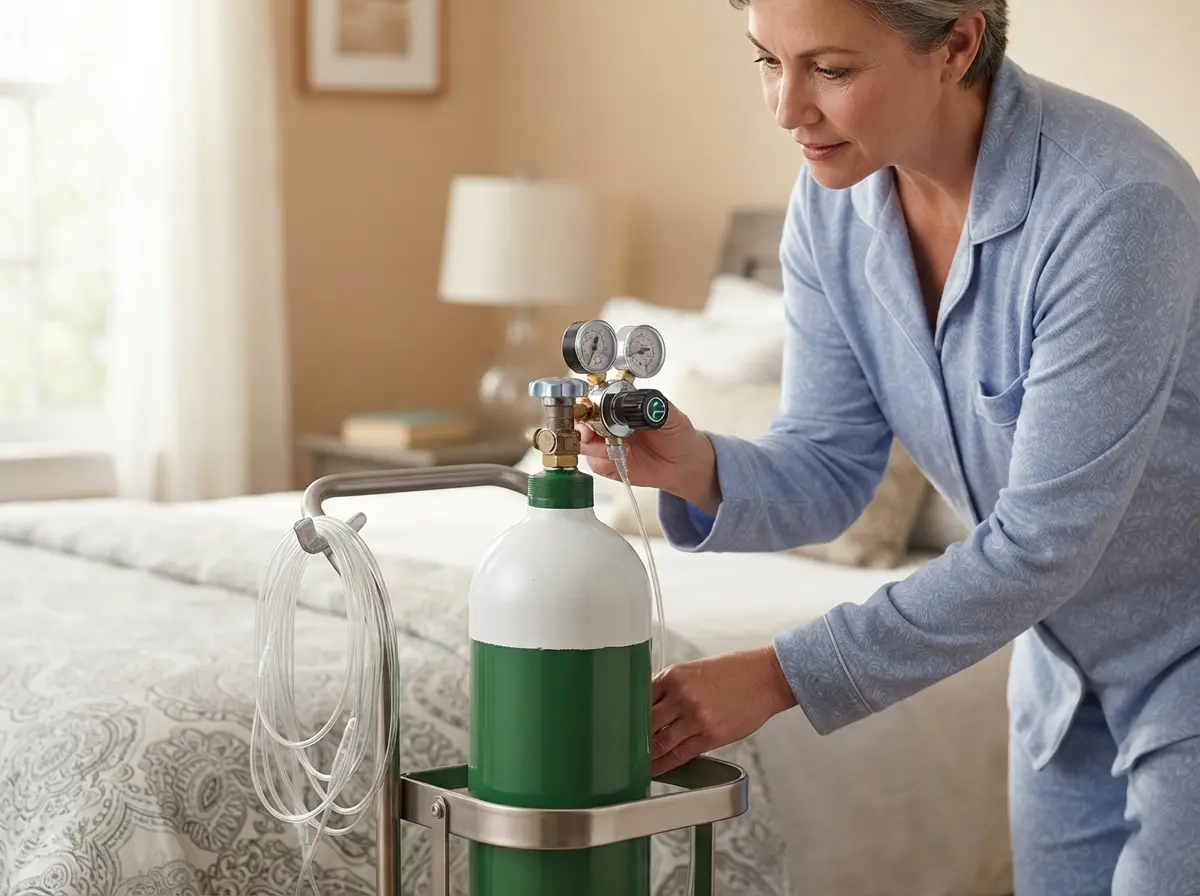
At home, the typical setup is a B Type or D Type jumbo cylinder with a regulator, flow meter, humidifier, and a nasal cannula or mask, plus the oxygen regulators and cylinder accessories that make the system safe. Duration depends on the prescribed flow rate: a B Type holds roughly 1,500 litres of oxygen when filled to about 150 bar (10 litres x 150 bar), so at 2 litres per minute it lasts around 12 hours, and a D Type jumbo, holding around 7,000 litres, lasts around 58 hours.
This article explains the difference between the gases, not treatment. Oxygen therapy, flow rates, and whether oxygen is needed at all are decisions for a qualified doctor, and a responsible supplier will ask for a prescription before supplying oxygen.
Can Industrial Oxygen Be Used for Patients?
No. This is the question that matters most, and the answer needs no hedging: industrial oxygen is not for human use.
The WHO is unambiguous: industrial and medical use are not interchangeable, industrial oxygen is not intended for human use, and possible particulate and microbial contamination create unacceptable risks for patients. Its good manufacturing practices for medicinal gases put it even more bluntly: industrial oxygen should not be used as a medicinal gas.
The reasons are practical, not legalistic:
- Contaminants. Industrial oxygen can carry carbon monoxide, moisture, oil residue, and particulates. Carbon monoxide binds to blood far more aggressively than oxygen does, and moisture and particulates can harm lungs; none are problems for a cutting torch.
- Filling and handling. Industrial cylinders and filling lines may not meet the cleaning standards required for breathing gas.
- Documentation. There is no batch test record proving the gas is safe to breathe.
During the 2020 COVID-19 surge, India redirected industrial oxygen production to medical supply, and industrial cylinders were formally converted to medical use through fast-tracked drug manufacturing licences under CDSCO oversight, PESO conversion procedures, dedicated production, testing, and documentation. What was never sanctioned was a patient breathing from a random industrial cylinder a local dealer happened to have. If someone offers you industrial oxygen "because it is basically the same," treat that as the red flag it is.
Why Medical Oxygen Has Stricter Quality Controls
The controls exist because the stakes are different. An industrial cylinder failure costs a workshop a batch. A medical gas failure costs a life.
Medical oxygen is made in dedicated, licensed premises, tested against pharmacopoeial limits, batch-sampled, documented, and traced from plant to patient. That apparatus exists for one reason: when a gas is going into a person's lungs, "probably fine" is not an acceptable specification.
It is also why medical oxygen costs more: every batch test, licence, inspection, and piece of dedicated equipment is a cost industrial oxygen does not carry. You are paying for assurance, and with something that goes into a human body, assurance is the product.
Price Differences
As a rule, medical oxygen costs more than industrial oxygen per unit, for the reasons above: licensing, dedicated premises, batch testing, documentation, and cleaner filling and handling. But prices are local, seasonal, and driven by availability, so no fixed number survives contact with the real market.
What we can tell buyers reliably:
- Medical oxygen carries compliance costs that industrial oxygen does not. Expect a premium, and be suspicious of anyone selling "medical oxygen" at welding-gas prices with no paperwork.
- Cylinder costs are separate from gas costs. A medical oxygen cylinder is a capital purchase, and refilling is a recurring cost. Our guide to the medical oxygen cylinder price in India breaks down what you actually pay for, including what a medical oxygen refill costs.
- Renting beats buying for short-term needs. For a few weeks of home oxygen, a deposit plus rent beats a full purchase; buying suits long-term use.
- Bulk changes the arithmetic. Hospitals and industries buying in bulk or liquid form get very different unit prices than a family refilling a single B Type.
- Location matters. Delivery distance, the number of refilling plants nearby, and the season all move the price. A quote from a metro is not comparable to a quote in a Bihar district town.
The honest advice: ask for a written quotation that separates gas, cylinder, delivery, and accessories, and compare like with like. If a price looks too good to be true for medical oxygen, it is almost certainly not medical oxygen.
Medical Oxygen vs Industrial Oxygen: Comparison Table
The full comparison, side by side:
Medical oxygen
- Intended use: breathing support and patient care.
- Regulatory status in India: a drug under the Drugs and Cosmetics Act, licensed by state drug controllers under CDSCO oversight.
- Key standards: Indian Pharmacopoeia monographs; WHO/International Pharmacopoeia Oxygen 99.5% (cryogenic) and Oxygen 93% (PSA).
- Purity: 99.5% minimum (cryogenic), 90–96% (PSA), with enforced contaminant limits.
- Batch testing: mandatory; certificate of analysis and documented records.
- Cylinder color in India: white shoulder, black body (IS 3933).
- Typical sizes: B Type, D Type jumbo, portable cylinders.
- Can it be breathed? Yes, as prescribed.
- Typical buyer: hospitals, clinics, home-care patients.
Industrial oxygen
- Intended use: welding, cutting, and manufacturing processes.
- Regulatory status in India: a compressed gas under the Gas Cylinder Rules, 2016 (PESO).
- Key standards: IS 4379 color code; performance-based specification.
- Purity: typically high, but no pharmacopoeial contaminant limits.
- Batch testing: process checks, no drug-licence regime.
- Cylinder color in India: black (IS 4379).
- Typical sizes: the same physical cylinders, with industrial fittings.
- Can it be breathed? No. Not for human use.
- Typical buyer: factories, fabricators, workshops.
One caution applies to both: oil and grease near oxygen are forbidden, because the reaction can be explosive.
Common Myths
"Industrial oxygen is the same gas, just sold cheaper." The molecule is the same; the product is not. Testing, contamination limits, filling hygiene, and documentation are all different, and that is what makes medical oxygen safe to breathe.
"During an emergency, any oxygen will do." During the 2020 crisis, India converted industrial production to medical use through formal processes: new licences, cylinder-conversion procedures, testing, and documentation. That is the opposite of "any cylinder will do."
"Oxygen cylinders explode on their own." Oxygen does not explode and is not flammable. What is dangerous is oxygen plus fuel: oil, grease, combustible material, and an ignition source. Keep those apart and cylinders are safe.
"A medical cylinder works fine for welding, so why keep them separate?" Physically it would run a torch, but it wastes drug-grade supply and muddies the stock systems that keep the two streams apart. Suppliers keep them separate on purpose, and buyers should too.
Frequently Asked Questions
1. What is the difference between medical and industrial oxygen?
Medical oxygen is produced, tested, and filled to pharmaceutical standards for breathing, and in India it is a drug. Industrial oxygen is for welding and manufacturing, and is not held to pharmacopoeial contaminant limits because it is not for human use.
2. Is industrial oxygen safe to breathe?
No. Industrial oxygen can contain carbon monoxide, moisture, particulates, and other impurities harmless in a flame but dangerous to a person. WHO guidance says industrial oxygen should not be used as a medicinal gas.
3. What is the purity of medical oxygen?
Cryogenic medical oxygen must contain not less than 99.5% oxygen by volume. PSA-produced medical oxygen is accepted at 93% ± 3%. Both must meet limits for carbon monoxide, carbon dioxide, and moisture.
4. What is the purity of industrial oxygen?
Industrial oxygen is commonly supplied at 99.5% or higher, but to a performance specification, not a pharmacopoeial one. The standard does not enforce the breathing-safety contaminant limits that medical oxygen requires.
5. Is medical oxygen a drug in India?
Yes. The Supreme Court confirmed in 2020 that medical oxygen is a drug under the Drugs and Cosmetics Act, 1940. Manufacturing, sale, and distribution require drug licences under CDSCO oversight.
6. Who regulates oxygen cylinders in India?
PESO administers the Gas Cylinder Rules, 2016, covering cylinder manufacture, filling, and periodic testing. Medical oxygen is additionally regulated as a drug by CDSCO and the state drug controllers.
7. Can industrial oxygen be used for patients in an emergency?
Not as a casual substitution. In the 2020 crisis, formal conversion processes were used: new licences, PESO-approved procedures, dedicated testing, and documentation. Breathing from a random industrial cylinder was never sanctioned.
8. How can I tell medical and industrial oxygen apart?
Read the label and cylinder markings, not just the paint. In India, medical oxygen cylinders have a white shoulder and black body (IS 3933); industrial oxygen cylinders are typically black (IS 4379); but color standards vary by country and manufacturer. When in doubt, do not use the cylinder.
9. Are medical and industrial oxygen cylinders the same?
Physically similar high-pressure cylinders, but they are identified, filled, inspected, and documented under different regimes. Medical cylinders are cleaned, filled, and labelled to drug standards; industrial cylinders are not.
10. Can my industrial cylinder be refilled with medical oxygen?
Only through the formal PESO conversion process: cleaning, inspection, re-marking, and documentation. A supplier cannot simply pump medical oxygen into an industrial cylinder and hand it to a patient.
11. Do I need a prescription for medical oxygen?
Responsible suppliers ask for a doctor's prescription before supplying medical oxygen for patient use. The prescription records the flow rate and duration, which is exactly what determines the right cylinder size.
12. Why is medical oxygen more expensive than industrial oxygen?
Licensing, dedicated manufacturing premises, batch testing, documentation, and cleaner filling and handling all cost money. With industrial oxygen you buy a gas; with medical oxygen you buy a gas plus certified assurance that it is safe to breathe.
13. What is the difference between Oxygen 93% and Oxygen 99.5%?
The two internationally recognized grades of medicinal oxygen. Oxygen 99.5% comes from cryogenic distillation; Oxygen 93% (90–96% v/v) from PSA plants. Both are acceptable when produced and tested to standard.
14. Why is oil so dangerous with oxygen?
Oil, grease, and other petroleum products react violently with high-pressure oxygen and can ignite and explode. That is why oxygen fittings must never be lubricated with ordinary oils and hands must be clean when handling equipment.
15. Does medical oxygen last longer than industrial oxygen in a cylinder?
Both are filled to similar pressures, so duration depends on flow rate and cylinder size, not grade: at 2 L/min, a B Type lasts roughly 12 hours and a D Type jumbo roughly 58 hours.
16. Where can I get medical oxygen in Khagaria, Bihar?
Prem Gas Solutions in Khagaria supplies medical oxygen, industrial gases, cylinder refilling, rental, exchange, cylinders, and accessories, with delivery across Khagaria and the surrounding blocks.
Final Summary
Medical oxygen and industrial oxygen share the same molecule but are entirely different products. Medical oxygen is a regulated drug: produced to pharmacopoeial standards, batch-tested, documented, and licensed from plant to patient. Industrial oxygen is a process gas, perfect for torches and furnaces and never for lungs. The differences show up in purity limits, testing, cylinder identification, color coding, storage, and safety rules, because the consequence of getting it wrong is not a wasted batch, it is a life.
The buying checklist is short: buy medical oxygen from a licensed medical gas supplier and industrial oxygen from an industrial gas supplier, never mix the two, read the labels, and keep every cylinder upright, secured, clean, and away from oil and fire.
If you are in Bihar and need medical oxygen, industrial gases, refilling, rental, or a quotation, contact Prem Gas Solutions in Khagaria by phone at 9470017017 or message us on WhatsApp. We will confirm availability, explain what you need, and keep the two kinds of oxygen exactly where they belong: separate, safe, and serving the right purpose.