How to Transport Gas Cylinders Safely, Rules for Bihar Businesses

Transporting compressed gas cylinders is one of the most critical logistical operations for industrial plants, fabrication workshops, construction projects, and healthcare facilities across Bihar. Whether moving a single B-type medical oxygen cylinder to a rural clinic or delivering dozens of 47-liter industrial argon and acetylene cylinders along the NH-31 industrial corridor, safety must take absolute priority.
A standard seamless steel gas cylinder operates under internal pressures ranging from 150 bar to 200 bar (approx. 2,100 to 3,000 PSI). To put this in perspective, a fully pressurized cylinder contains potential energy equivalent to several sticks of dynamite. If a cylinder valve is sheared off during transport because the cylinder was unsecured or dropped, the sudden release of gas turns the 60 to 70 kg steel vessel into an unguided rocket capable of penetrating brick walls and crushing vehicle cabs.
For business owners, fleet managers, and workshop supervisors in Khagaria, Begusarai, Patna, Barauni, Bhagalpur, and Muzaffarpur, complying with transportation safety standards is not merely a legal checkbox to satisfy District Transport Office (DTO) inspectors—it is an essential operational safeguard against catastrophic explosions, fatal injuries, and crippling business liability.
The Legal and Statutory Framework in India & Bihar
The transport of compressed, liquefied, and dissolved gases in India is governed by strict statutory regulations enforced by the Petroleum and Explosives Safety Organisation (PESO), Ministry of Commerce and Industry, alongside the Ministry of Road Transport and Highways (MoRTH).
1. PESO Gas Cylinders Rules, 2016
Under Chapter V of the Gas Cylinders Rules, 2016, specific mandatory conditions apply to any vehicle transporting gas cylinders:
- Rule 43 (Transport of Cylinders): Cylinders filled with compressed or liquefied gas must not be transported in any vehicle unless they are securely held in place by racks, cradles, or straps to prevent movement, rolling, or friction sparks.
- Rule 44 (Restriction on Transport): Flammable or toxic gas cylinders must never be transported in the same compartment as passenger luggage, foodstuffs, or combustible material.
- Rule 35 (Hydrostatic Testing & Certification): Every compressed gas cylinder must possess a valid, unexpired statutory hydrostatic stretch test certificate (mandatory every 5 years for permanent industrial/medical gases like oxygen, nitrogen, and argon, and every 2 years for specific corrosive gases). Transporting an expired or uncertified cylinder is a severe legal offense under the Explosives Act, 1884.
2. Central Motor Vehicles Rules (CMVR), 1989
Vehicles carrying compressed gas cylinders fall under the hazardous goods transport category:
- Rule 9 (Driver Training & Certification): Drivers operating vehicles loaded with hazardous cargo must possess a valid commercial driving license endorsed specifically for carrying hazardous goods, requiring a specialized training course in emergency response, leak containment, and fire safety.
- Rule 129 (Emergency Information Panel & Hazchem Placards): Vehicles must display class 2 hazard placards (Class 2.1 Flammable Gas, Class 2.2 Non-Flammable Non-Toxic Gas, or Class 2.3 Toxic Gas) on the front, rear, and both sides of the vehicle body.
- Transport Emergency Card (TREMCARD): The driver must carry a written TREMCARD inside the cab detailing the specific physical properties of the gases loaded, emergency response protocols, toxicity risks, and contact details for emergency services and the gas supplier.
Technical Physics of Gas Cylinder Transport Risks
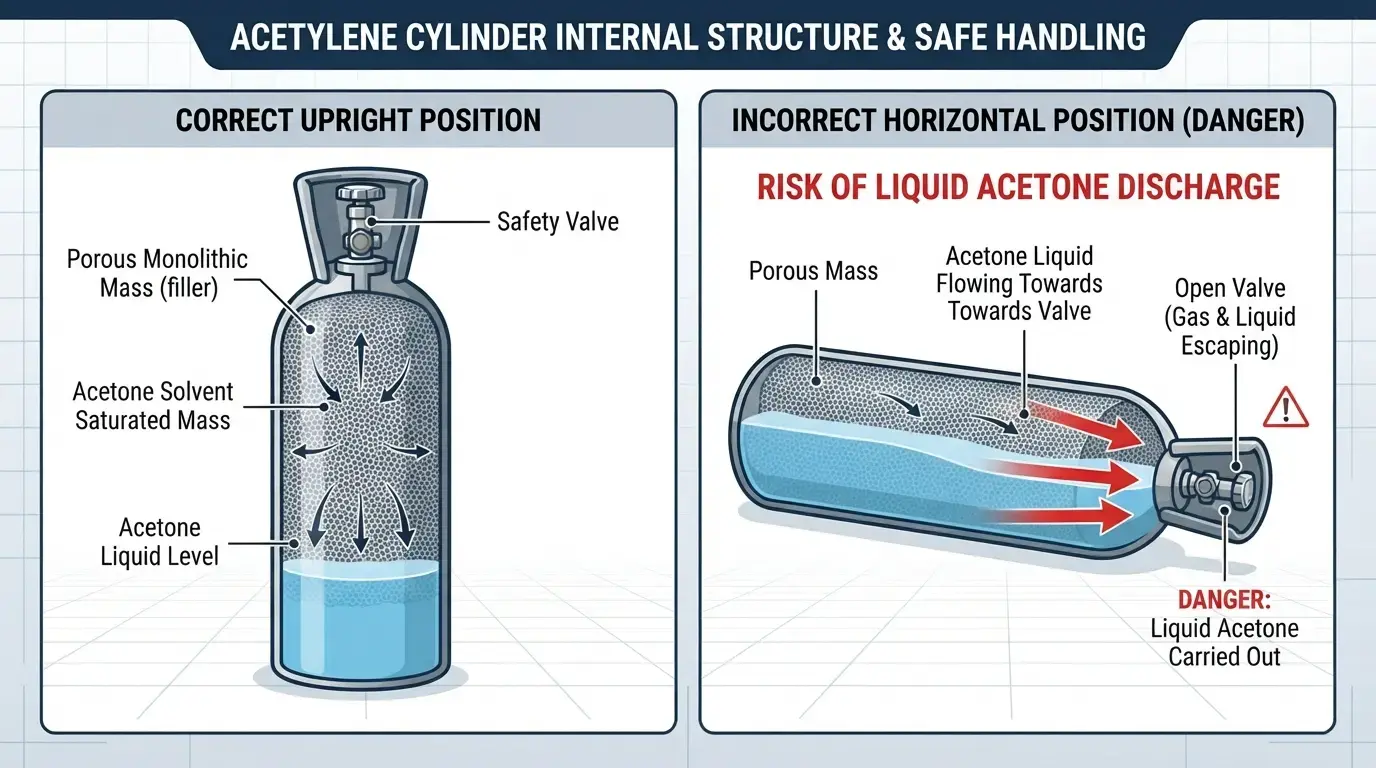
Understanding why gas cylinders react dangerously under transit stress helps workforce teams build effective safety habits.
1. Acetylene Transport Physics: Why Lying Flat Is Extremely Dangerous
Unlike compressed oxygen or nitrogen, acetylene gas (C2H2) is chemically unstable under pressure above 2 bar. To store acetylene safely at 15 to 18 bar inside a cylinder, the vessel is filled with a porous mass (calcium silicate) saturated with liquid acetone. Acetone dissolves up to 25 times its volume of acetylene per bar of pressure.
When an acetylene cylinder is laid horizontally on a truck bed:
- Liquid acetone travels into the valve body and regulator passages.
- Liquid acetone leaks out when the valve is opened, dissolving rubber hoses and brass regulator seats.
- Displaced acetone leaves empty pockets inside the upper porous mass, allowing free acetylene gas to collect and spontaneously decompose, leading to violent internal explosion.
Mandatory Rule: Acetylene cylinders must ALWAYS be transported, stored, and used in a strictly vertical, upright position. If an acetylene cylinder is accidentally transported horizontally, it must be placed upright and left unused for at least 24 hours before opening the valve to allow acetone to settle back down.
2. Oxygen & Hydrocarbon Ignition Risk
Compressed oxygen is a powerful oxidizer. If petroleum-based grease, diesel fuel, engine oil, or hydraulic fluid comes into contact with high-pressure oxygen valve threads, the resulting adiabatic compression causes rapid heat generation and violent exothermic reaction—causing spontaneous ignition or explosion without needing a spark or flame.
Pre-Transit Checklist: Preparing Cylinders for Transport
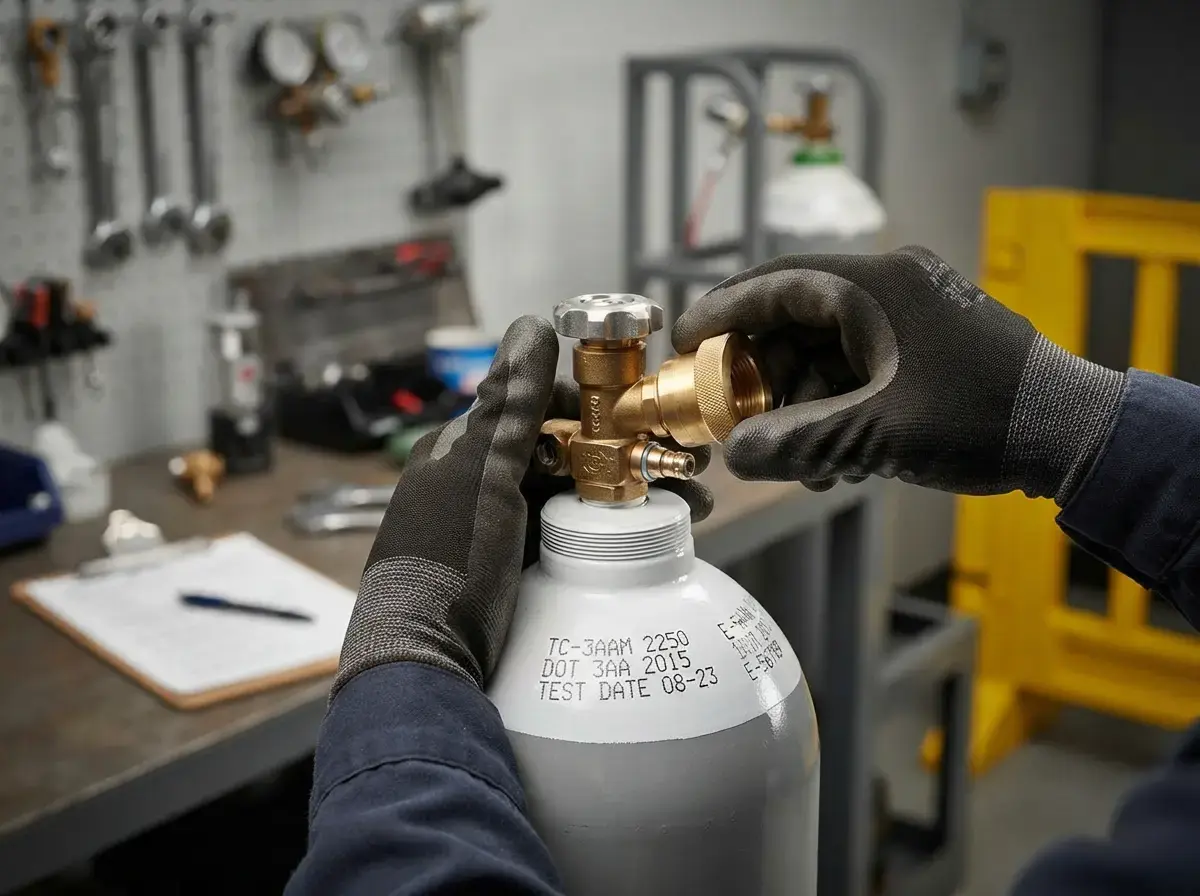
Before loading any cylinder onto a delivery vehicle or pickup truck, perform this mandatory 5-point pre-dispatch inspection:
- 1. Valve Protection Cap: Heavy-duty steel cap or tulip guard screwed down tight over valve. Never load without an approved cap.
- 2. Hydrostatic Test Date: Stamped on collar/shoulder (e.g., 04-24 = April 2024). Date must be within 5 years. Quarantine expired cylinders immediately.
- 3. Valve & Thread Inspection: Valve closed completely by hand key; threads clean, dry, and oil-free.
- 4. Leak Check: No bubbling when tested with approved leak detection solution or soap water. NEVER use open flames to test for leaks.
- 5. Color Coding (IS 3050/4379): Body painted per statutory gas standard (Black with White shoulder for Industrial Oxygen, All White for Medical Oxygen, Maroon for Acetylene, Peacock Blue for Argon).
To equip your logistics team with statutory caps, brass keys, and valve protection gear, review our detailed guide on gas cylinder safety caps, valves, and handling equipment.
Vehicle Requirements & Loading Best Practices
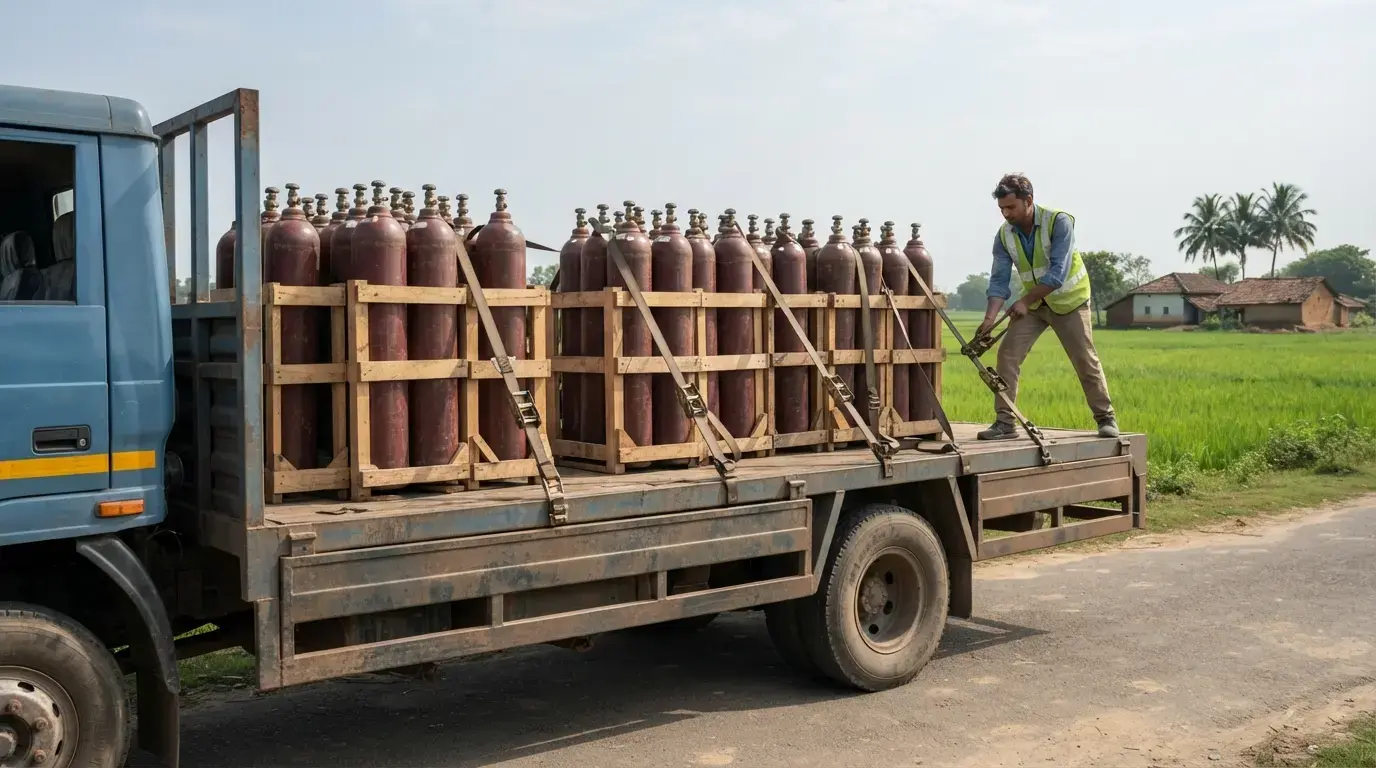
Not every vehicle is legal or safe for transporting compressed gas cylinders across Bihar roads.
1. Approved Vehicle Specifications
- Open-Top or Well-Ventilated Cargo Beds: Cylinders must be transported in open-body trucks, pickup beds with mesh sides, or specialized cylinder transport vehicles. NEVER transport gas cylinders in closed passenger cars, enclosed vans, or locked car trunks. Small gas leaks in an enclosed space quickly create an explosive or asphyxiating atmosphere.
- Wooden Flooring or Heavy Rubber Mats: Cargo beds should feature non-sparking wooden floors or thick rubber matting to prevent friction sparks and reduce road vibration transmission.
- Exhaust Pipe Spark Arrestors: Commercial vehicles carrying flammable gases (Acetylene, Hydrogen) must have the exhaust tailpipe fitted with a certified spark arrestor directed away from the cargo area.
2. Securing and Restraint Rules
- Vertical Steel Racks: Cylinders should ideally be loaded vertically inside dedicated steel rack compartments with individual chain latches or heavy-duty ratchet straps.
- Horizontal Transport (Non-Liquefied Permanent Gases Only): If compressed oxygen, nitrogen, or argon cylinders must be laid horizontally due to low vehicle height limits, they must lie parallel to the vehicle sides (lengthwise) and be wedged with wooden chocks and rubber blocks to prevent rolling.
- No Overhanging or Stacking: Cylinders must never overhang the vehicle sides or tailgate. Never stack loose cylinders directly on top of each other without specialized tiered racking.
For heavy-duty handling accessories and vehicle mounting hardware, explore our dedicated line of cylinder safety trolleys, keys, and transit hardware.
Gas Segregation Rules during Transport
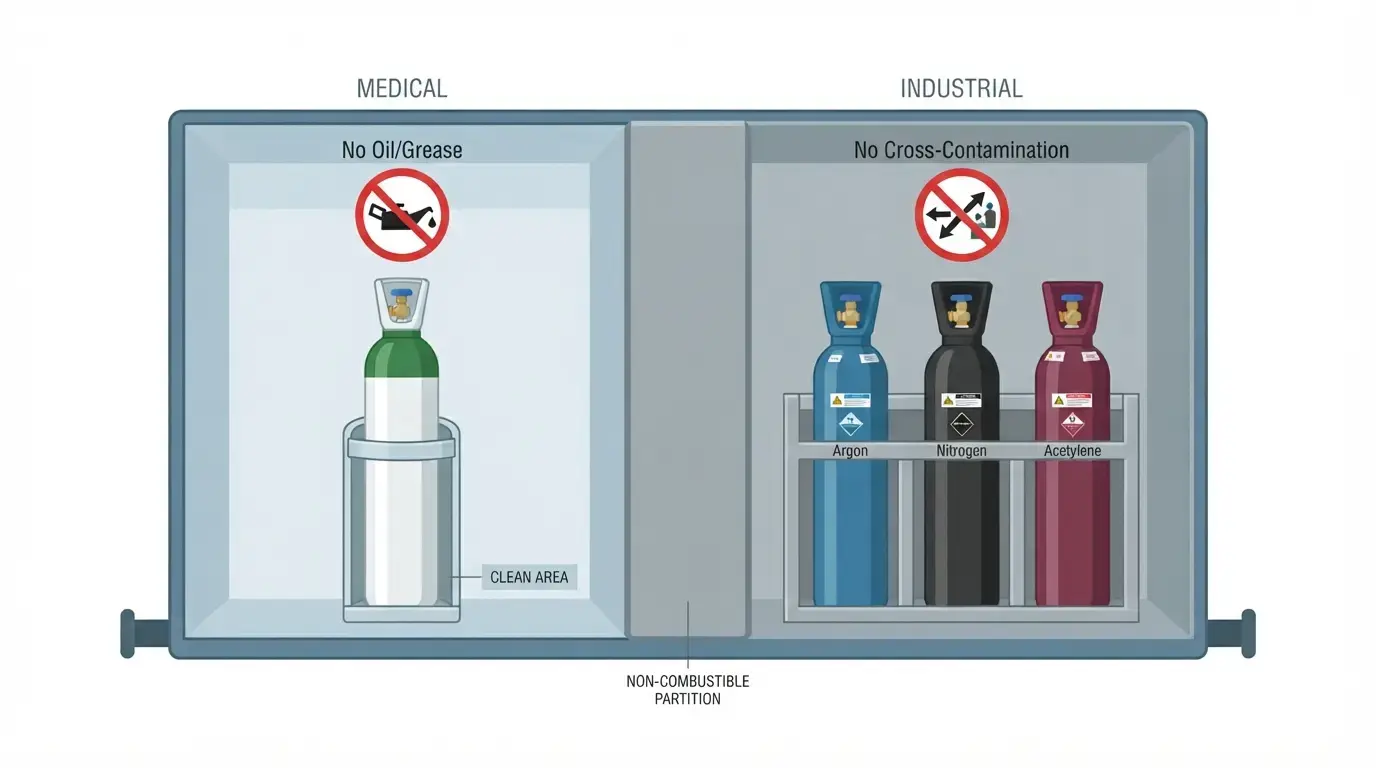
When carrying multiple gas types on a single delivery vehicle, cross-reactivity must be strictly managed:
- Flammable vs. Oxidizing Separation: Flammable gases (Acetylene, LPG) and Oxidizing gases (Oxygen, Nitrous Oxide) must never share the same transport space unless separated by a continuous, gas-tight, non-combustible steel bulkhead at least 1.5 meters high.
- Inert Gas Compatibility: Inert gases (Argon, Nitrogen, CO2) can be safely loaded alongside either flammable or oxidizing cylinders, provided all cylinders are secured independently.
Medical Oxygen vs. Industrial Gas Transport
Medical oxygen cylinders supplied to hospitals and clinics must be maintained to strict hygienic standards. They must NEVER be transported alongside dirty industrial cylinders, oil drums, scrap metals, or toxic chemicals. To understand purity, cleaning, and valve standards, refer to our comprehensive guide on the differences between medical and industrial gas handling.
Navigating Bihar Highway Conditions: Climate & Road Challenges
Logistics operations along Bihar's major transit routes—such as NH-31 (connecting Barauni, Begusarai, Khagaria, and Purnea) and NH-30 (Patna belt)—face unique environmental conditions.
1. Extreme Summer Heat Management (42°C to 45°C)
During Bihar summers, ambient temperatures in open vehicle beds can push internal gas pressures beyond safe working limits due to thermal expansion.
- Shaded Tarpaulins: Open truck beds must be covered with light-colored, flame-retardant canvas tarpaulins elevated at least 20 cm above cylinder tops to allow continuous airflow. Never wrap tarpaulins tightly around cylinders, as this creates a heat trap.
- No Direct Sun Parking: Drivers must never park loaded gas transport vehicles in direct sunlight during roadside meal stops or rest breaks.
2. Road Vibration & Pothole Mitigation
Rural links and under-construction highway stretches produce heavy vertical chassis shock. Ensure vehicle leaf spring suspensions are well-maintained and use thick rubber separation pads between adjacent cylinders to prevent metal clashing, which can damage cylinder walls over time.
3. Highway Inspection Compliance (DTO & Police)
District Transport Office (DTO) teams regularly check commercial freight vehicles across Bihar. To avoid roadside impoundment or severe fines, ensure the vehicle cab contains a copy of the PESO License, Driver Hazardous Cargo CMVR Certificate, TREMCARD, MSDS, and valid vehicle fitness and PUC documents.
Emergency Response Procedure: 5-Step Roadside Action Plan
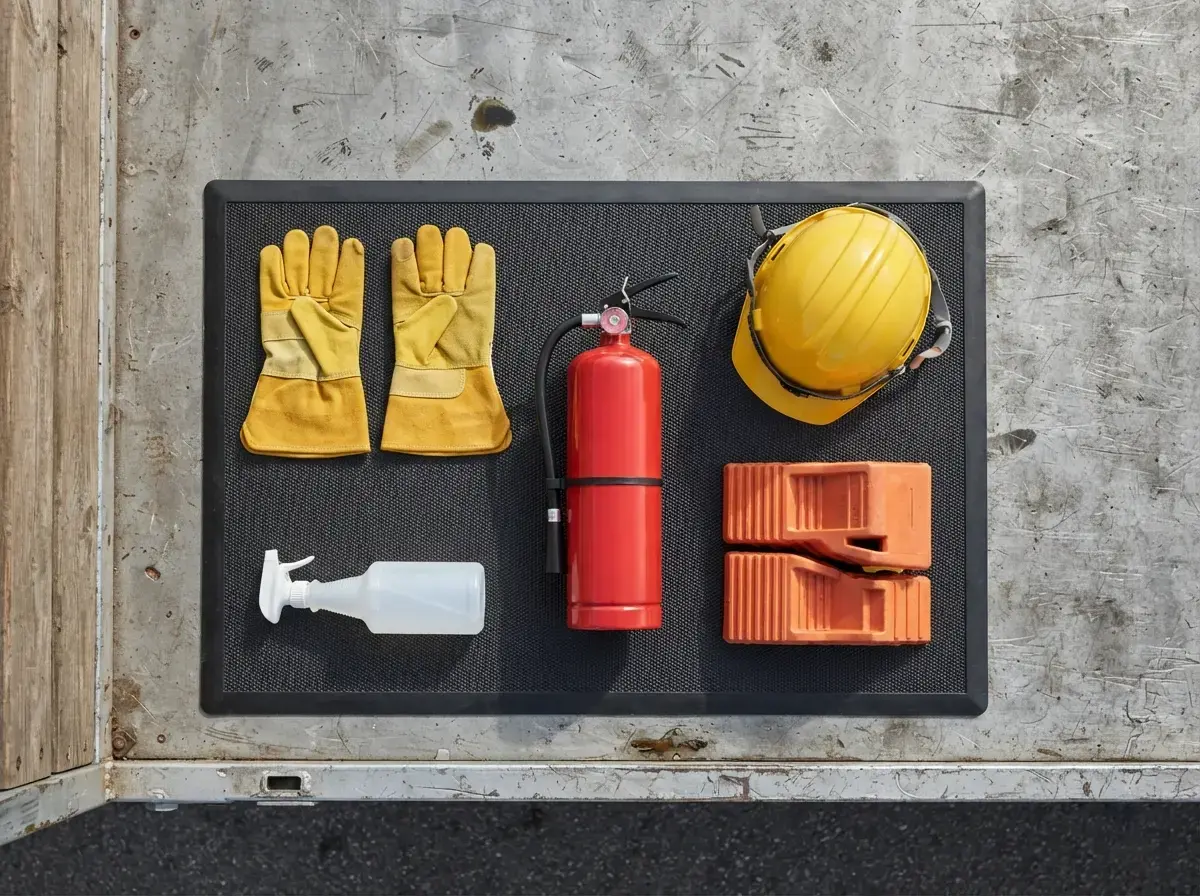
If a gas leak, vehicle accident, or fire occurs during cylinder transport:
- SAFE STOP: Immediately pull the vehicle off the main highway onto a wide, clear shoulder away from populated areas, open flames, and electrical lines.
- ENGINE OFF & ISOLATE: Turn off the ignition, engage the handbrake, and disconnect the battery isolator switch if safe to do so. Ban all smoking and open flames within 50 meters.
- EVACUATE & CORDONS: Evacuate non-essential personnel upwind of the leak. Set up warning triangles 50 meters ahead and behind the vehicle.
- FIRE EXTINGUISHER READY: Keep two 9 kg ABC Dry Powder fire extinguishers ready. If a gas leak occurs without fire, do not attempt to ignite it. If a cylinder valve area is on fire, cool the cylinder body with water fog from a safe distance only if trained to do so.
- CALL EMERGENCY SERVICES: Immediately alert local authorities (Police Emergency: 112, Fire Brigade: 101) and the Prem Gas Solutions Helpline at +91 9470017017.
Partner with Prem Gas Solutions for Compliant Deliveries
Navigating gas cylinder safety regulations requires reliable equipment, certified refilling processes, and trained delivery personnel. At Prem Gas Solutions, every cylinder supplied from our Khagaria facility undergoes rigorous statutory testing, precision valve inspection, and safe, compliant transport protocols.
Whether you operate a healthcare facility requiring dedicated medical oxygen or an industrial fabrication unit needing bulk argon, nitrogen, or acetylene, our team delivers certified gas solutions straight to your site with complete peace of mind.
For certified gas supply, cylinder refills, or technical hardware inquiries, explore our range of industrial and medical oxygen gas cylinders in Khagaria or contact Prem Gas Solutions directly today.