Why Nitrogen Gas Is Used in Food Packaging, Manufacturing and Other Industries
Introduction: The Inert Workhorse Behind Modern Industry
Nitrogen makes up 78% of Earth's atmosphere, yet most people never think about it. We breathe it in and out with every breath, and it passes through us without doing anything. But strip nitrogen from the air, purify it to 99.9% or higher, compress it into a steel cylinder at 150 to 200 bar, and it transforms into one of the most versatile tools in modern industry. Colourless, odourless, and chemically inert thanks to its strong triple covalent bond, nitrogen (N2) refuses to react with other elements under normal conditions. That single property — inertness — is why nitrogen is indispensable across food packaging, laser cutting, electronics manufacturing, chemical processing, pharmaceutical production, and dozens of other applications.
For plant managers, procurement teams, and fabrication shop owners across Bihar, understanding the numbers behind nitrogen's applications turns a commodity gas into a strategic lever. When you know that residual oxygen below 2% in a chip packet extends shelf life from 30 days to a full year, or that nitrogen assist gas at 12 to 16 bar produces oxide-free stainless steel edges that need no grinding, you stop treating nitrogen as just another cylinder on the invoice and start treating it as a quality tool. Whether you are exploring our comprehensive guide to industrial and medical gases or specifying a new production line, this post breaks down the data-backed reasons nitrogen is the go-to shielding, purging, and blanketing medium worldwide — and what it means for your operation in Bihar.
Food Packaging (MAP): The Numbers Behind Shelf-Life Extension
Every food producer in India — from a small namkeen manufacturer in Khagaria to a large-scale chips plant in Patna — fights the same enemy: spoilage. Food spoilage is driven by two mechanisms working simultaneously. First, oxidation attacks fats and oils, turning them rancid, fading colours, and producing off-flavours. Second, aerobic microorganisms — bacteria, moulds, and yeasts that need oxygen to survive — multiply rapidly on the food surface, breaking down proteins and carbohydrates. Together, these two processes can reduce a freshly packed product from shelf-ready to unfit for sale in days.
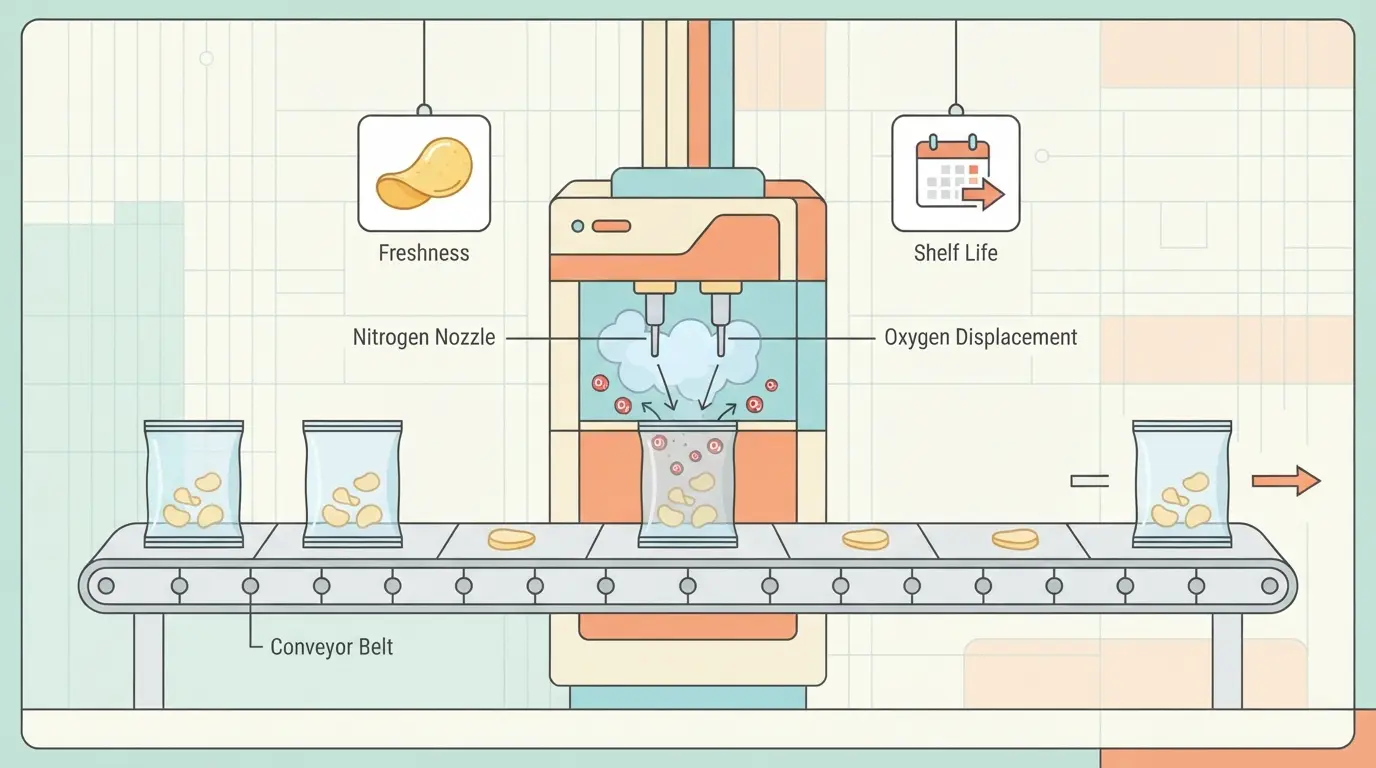
Ambient air contains approximately 21% oxygen (209,000 parts per million). Modified Atmosphere Packaging (MAP) addresses both spoilage mechanisms by displacing that oxygen with nitrogen, typically driving residual O2 below 1% — often to less than 0.5% for oxygen-sensitive products like nuts, coffee, and snack foods. The nitrogen does not just remove oxygen; it also absorbs residual moisture, provides a cushioning gas pressure inside flexible pouches, and diffuses very slowly through packaging films, maintaining the modified atmosphere for months.
How the MAP Process Works on a Production Line
On a typical snack packaging line using a Vertical Form Fill Seal (VFFS) machine, the process runs continuously at high speed. The packaging film is formed into a pouch, the product is dropped in, and just before sealing, a nozzle injects a burst of food-grade nitrogen into the pouch headspace. The nitrogen flushes out ambient air, and the pouch is sealed with the inert atmosphere trapped inside. The entire cycle — from product drop to sealed pouch — takes less than a second on modern lines running at 60 to 120 bags per minute.
The critical quality parameter is residual oxygen. If the nitrogen flush is too brief or the flow rate too low, pockets of air remain, and those pockets become the starting point for spoilage. Manufacturers use headspace oxygen analysers to test sealed packages in real time, typically sampling every 100 to 500 units. The target varies by product: potato chips tolerate up to 2% residual O2, but nuts and coffee demand less than 1% to prevent lipid oxidation. When residual oxygen is properly controlled, the results are dramatic.
Typical MAP Gas Compositions and Shelf-Life Gains
| Product Category | Typical MAP Mix | Residual O2 Target | Shelf Life (Air vs MAP) | Key Mechanism |
|---|---|---|---|---|
| Potato chips, extruded snacks | 100% N2 | <2% | 30-60 days vs 180-365 days | Oxidation prevention + mechanical cushioning |
| Nuts, seeds, dried fruit | 100% N2 | <1% | 30-60 days vs 180-365 days | Prevents lipid oxidation and rancidity |
| Roasted coffee (beans/ground) | 100% N2 | <1% | 30-90 days vs 180-365 days | Preserves volatile aroma compounds 12+ months |
| Cheese and dairy | 100% N2 or 70% N2 / 30% CO2 | <1% | 7-21 days vs 60-120 days | Inhibits mould and aerobic bacteria |
| Fresh pasta and bakery | 100% N2 | <1% | 14-30 days vs 60-180 days | Prevents oxidative spoilage and mould |
| Poultry and fish | 30% CO2 / 70% N2 | <1% | 3-5 days vs 14-21 days | CO2 antimicrobial + N2 filler |
| Fresh red meat | 70% O2 / 30% CO2 (high-O2 MAP) | High O2 | 5-14 days vs 21-28 days | Maintains bright red colour (oxymyoglobin) |
These are not theoretical numbers. The data comes from published MAP research and production-trial results from packaging equipment manufacturers. A snack manufacturer running 100% nitrogen flush on potato chips can extend shelf life from roughly two months to a full year — a six-fold improvement — without adding any chemical preservatives. For coffee, the benefit is even more pronounced: roasted coffee loses its volatile aroma compounds within weeks when exposed to air, but sealed in 100% nitrogen, the aroma stays intact for 12 months or longer.
Why Food-Grade Purity Matters
Not all nitrogen is suitable for food contact. Food-grade nitrogen must meet strict purity and contamination standards set by regulatory bodies worldwide. In the United States, the FDA classifies nitrogen as Generally Recognized as Safe (GRAS) under 21 CFR 184.1540. In the European Union, it is approved as food additive E941 under Regulation 231/2012. The typical purity requirement for MAP applications is 99.9% or higher, with oil content below 0.5 mg/m3, moisture below 67 ppm (dew point -47 degrees Celsius or drier), and zero viable microorganisms.
Using industrial-grade nitrogen (which may contain trace oil vapour, moisture, or particulates from the compressor) in food packaging is a serious food safety risk. Contaminated nitrogen can introduce off-flavours, support microbial growth, and trigger product recalls. For food processors in Bihar, the rule is simple: always insist on food-grade certification and a Certificate of Analysis (COA) from your nitrogen supplier.
The Food-Waste Problem MAP Helps Solve
The scale of food waste globally is staggering. FAO reports that 13.2% of all food produced is lost post-harvest, before it ever reaches retail shelves — rotted in storage, damaged in transport, or spoiled in distribution. UNEP's 2024 Food Waste Index adds that a further 1.05 billion tonnes were wasted in 2022 at the retail, food-service, and household levels, representing 19% of all food available to consumers. The economic toll is estimated at approximately $1 trillion annually, and food loss and waste together account for 8-10% of global greenhouse gas emissions — more than the aviation industry.
MAP is one of the most effective, scalable tools for reducing post-harvest and retail food waste. The European Union's Farm-to-Fork Strategy explicitly cites MAP as a validated technology for achieving its target of halving food waste by 2030. France's anti-waste law grants preferential status to retailers implementing certified MAP solutions. For Indian food producers exporting to these markets, MAP compliance is not optional — it is a market-access requirement.
MAP Market Growth
The global modified atmosphere packaging market was valued at USD 16.03 billion in 2024 and is projected to reach USD 26.18 billion by 2030, growing at a compound annual growth rate (CAGR) of 7.94% (Grand View Research, 2025). Asia-Pacific is the fastest-growing region, accounting for approximately 38% of global revenue in 2025 and growing at roughly 10% CAGR. India's organised retail sector, cold-chain infrastructure expansion, and rising packaged-food consumption are the primary demand drivers. For snack manufacturers, dairy processors, and ready-to-eat meal producers in Bihar, MAP adoption is not just a quality improvement — it is becoming a competitive necessity.
Laser Cutting and Metal Fabrication: Pressure, Purity, and Edge Quality
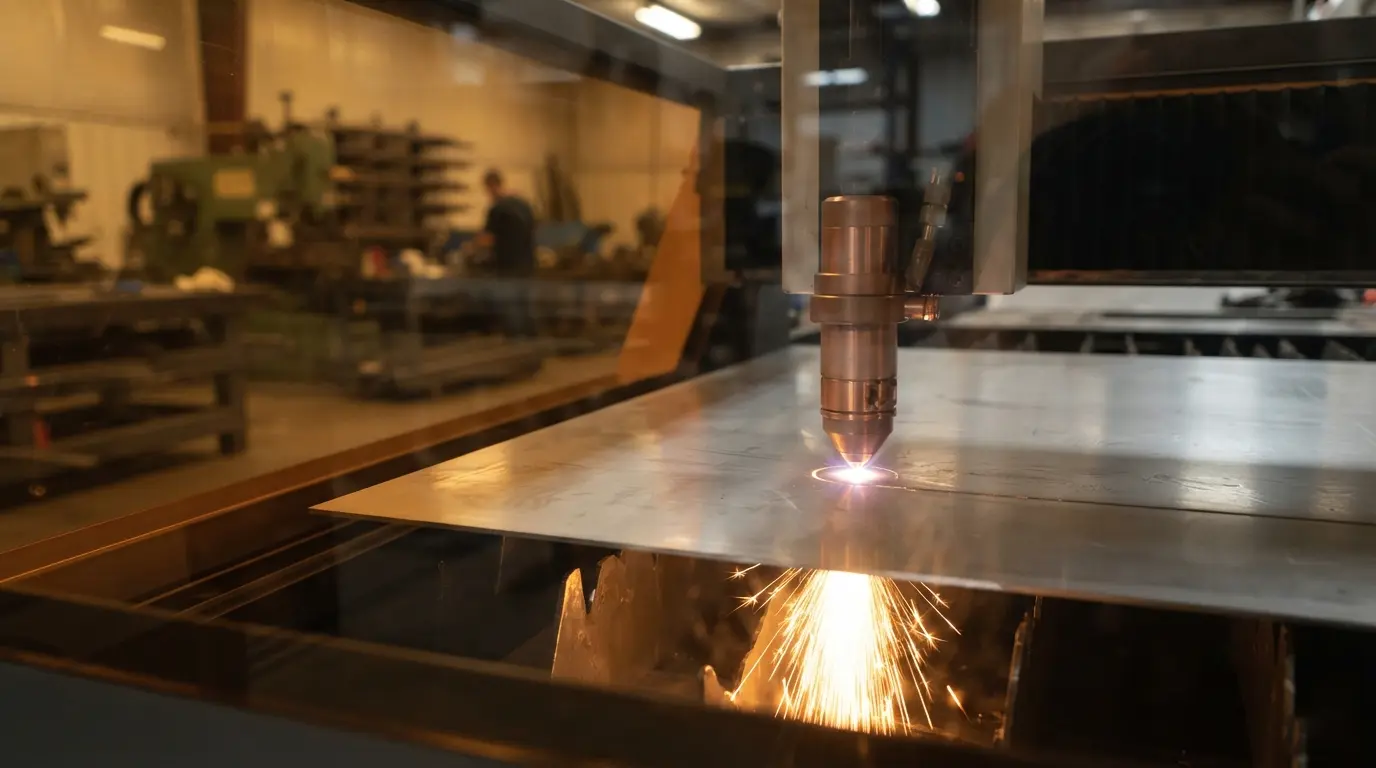
Modern metal fabrication in Bihar — from stainless steel kitchen equipment for hospitals to structural components for construction — increasingly relies on fiber laser cutting machines. These machines use a focused beam of coherent light to melt through metal, and the assist gas ejected through the nozzle alongside the beam determines the quality of the cut edge. The choice of assist gas is not arbitrary; it is a technical decision with direct consequences for edge finish, downstream processing cost, and production speed.
How Nitrogen Assists the Cutting Process
In fiber laser cutting, the assist gas performs two critical functions. Mechanically, it ejects molten metal from the kerf (the narrow slot created by the laser) before it re-solidifies — this is what produces a clean cut rather than a ragged, dross-covered edge. Chemically, the gas either protects the cut surface from oxidation (if inert, like nitrogen) or participates in an exothermic reaction that adds cutting energy (if reactive, like oxygen). Nitrogen does not react with the metal; it relies purely on mechanical force — high-pressure gas momentum — to blast the melt out of the kerf. This is why nitrogen cutting requires much higher pressures (10 to 25 bar) compared to oxygen cutting (0.5 to 2 bar).
The result on stainless steel is a bright, silvery cut face with no oxide layer, no discoloration, and no need for post-cut grinding, pickling, or passivation. For food-equipment fabrication (where smooth, crevice-free surfaces are hygiene requirements), pharmaceutical-grade stainless steel components, and architectural panels, this oxide-free finish is non-negotiable. Oxygen-assist cutting of stainless steel produces a contaminated chromium-oxide edge that ruins corrosion resistance and makes welding unreliable — it is simply not acceptable for these applications.
Assist-Gas Pressure by Material and Thickness (Fiber Laser)
| Material / Thickness | Gas | Nozzle Pressure | Edge Result | Notes |
|---|---|---|---|---|
| Stainless 1-6 mm | N2 (99.9%+) | 10-16 bar | Bright, oxide-free, weld-ready | Standard production range |
| Stainless 6-12 mm | N2 (99.9%+) | 16-20 bar | Bright, oxide-free | Larger nozzle; reduced speed |
| Stainless 10-15 mm | N2 (99.9%+) | 18-25 bar | Bright, oxide-free | High-power machine required |
| Aluminum 1-6 mm | N2 or dry air | 12-16 bar | Clean, anodize-ready | Air acceptable for thin non-cosmetic |
| Carbon steel 1-6 mm (weld-ready) | N2 (99.9%+) | 10-18 bar | Bright, oxide-free | 20-30% slower than O2 assist |
| Carbon steel 6-20 mm (structural) | O2 (99.5%+) | 0.5-2 bar | Dark oxide layer | Exothermic reaction adds 30-40% cutting energy |
The Cost Trade-Off: Gas Price vs. Rework Cost
Nitrogen is more expensive per cutting minute than oxygen. Industry data shows nitrogen assist running at approximately USD 0.20 to 0.40 per minute (rising to USD 0.60+ at high-pressure settings for thick material), compared to USD 0.05 to 0.15 per minute for oxygen. But the gas cost is only half the equation. When oxygen-cut stainless steel edges require grinding, acid pickling, or mechanical cleaning before welding or powder coating, the labour and material cost of that rework often exceeds the gas-price difference. A fabrication shop in Bihar running stainless steel cuts for hospital food trays or pharmaceutical equipment will find that nitrogen's premium pays for itself in eliminated rework hours.
The speed penalty is real but manageable. Nitrogen-assist carbon-steel cutting runs at roughly 70 to 80% of the speed of oxygen-assist on the same thickness and power level. For structural carbon steel where the edge will be hidden inside a welded assembly, oxygen remains the faster, cheaper choice. But for any stainless steel or aluminum work, or for carbon-steel parts that must go directly to welding or powder coating without cleaning, nitrogen is the standard.
Purity Requirements for Laser Cutting
Assist-gas purity directly affects edge quality. For stainless steel laser cutting, the minimum purity is typically 99.9%, with many shops specifying 99.95% or higher for critical applications. Oxygen impurities in the nitrogen stream cause micro-oxidation on the cut face, visible as faint yellow or blue discoloration. For most structural work, this is cosmetic and acceptable; for food-equipment or pharmaceutical-grade fabrication, even minor discoloration is rejected. Premium high-pressure nitrogen generators can produce 99.999% (5.0 grade) purity, which is overkill for most laser cutting but standard for semiconductor and electronics manufacturing.
 Electronics Manufacturing: Reflow Soldering Defect Reduction
Surface-mount technology (SMT) assembly — the process of soldering tiny components onto printed circuit boards — is extremely sensitive to oxygen. During reflow soldering, the board passes through an oven with a controlled temperature profile that melts the solder paste, forming electrical and mechanical joints between component leads and PCB pads. If oxygen is present in the oven atmosphere, it reacts with the molten solder and the exposed copper pads, forming tin-oxide and copper-oxide layers that impair solder wetting, increase voiding, and produce weak, unreliable joints.
How Nitrogen Improves Soldering Quality
In a nitrogen reflow oven, the oxygen concentration drops from ambient ~209,000 ppm to below 1,000 ppm — typically 500 to 1,000 ppm for standard assemblies, and below 100 ppm for ultra-fine-pitch components and BGAs (ball grid arrays). This near-total oxygen removal has a measurable impact on every quality metric:
- Overall defect rate: Production trials at Xetel Corp. (Austin, Texas) showed solder defect levels falling from 1,250 ppm in air to 275 ppm in nitrogen — a 75% reduction across more than 2.5 million solder joints over two months of production.
- Non-wetting defects: Reduced by 85% or more. Non-wetting — where solder fails to bond to the pad or lead — is the most difficult defect to detect visually and the most common cause of field failures.
- Solder bridging: Reduced by approximately 78%. Bridging — where solder connects two adjacent pads that should be separate — causes short circuits and board failures.
- Insufficient solder defects: Reduced by approximately 77%. These include cold joints, open circuits, and voids under component leads.
- Wetting force: Increased by approximately 11% at 7 ppm O2 compared to air (using RMA flux). Stronger wetting force means solder spreads more completely across the pad, filling the joint more thoroughly.
- Wetting time: Increased by approximately 50% in nitrogen versus air. Faster wetting means the solder forms a complete joint within a narrower temperature window, reducing the risk of heat damage to sensitive components.
- Solder spread temperature: Research by Air Products and Chemicals showed Sn63/Pb37 solder spreading at 205 degrees Celsius in 10 ppm O2 but requiring 270 degrees Celsius in 1,000 ppm O2 — a 65-degree difference that directly impacts the thermal profile and component safety.
Wave Soldering: Dross Reduction and Cost Savings
The benefits extend beyond reflow to wave soldering, where the board passes over a wave of molten solder. In an air atmosphere, the exposed solder surface oxidises rapidly, forming dross (oxide skim) that must be removed regularly. One electronics manufacturer documented dross generation of approximately 30 kg per week in a partially inerted wave system, compared to just 5 kg per week in a full-tunnel nitrogen system. The solder consumption cost dropped from approximately 275 EUR per week to 48 EUR per week, and maintenance time fell from 7.5 hours per week to 1.1 hours per week. Across a year, the savings from reduced solder consumption, reduced dross disposal, and reduced maintenance downtime can exceed 120,000 EUR for a single production line.
When Nitrogen Reflow Is Essential
Nitrogen reflow is not always necessary — many simple assemblies solder reliably in air with proper process control. But nitrogen becomes essential when the process demands are high: bottom-terminated components (QFNs, LGAs) where voiding is a critical concern, fine-pitch packages where wetting performance determines yield, high-reliability sectors (automotive, aerospace, medical) where cosmetic and structural criteria are strict, and low-residue or low-activity fluxes that rely on a clean atmosphere for effective performance. For EMS partners in Bihar or Jharkhand serving automotive or medical OEMs, nitrogen reflow is standard practice.
Chemical, Pharma, and General Industrial: Purging, Blanketing, and Inerting
Beyond food packaging and laser cutting, nitrogen serves a broad range of chemical, pharmaceutical, and general industrial applications — all leveraging the same core property: inertness.
Tank Blanketing and Headspace Inerting
Storage tanks containing flammable solvents, edible oils, or reactive chemicals are blanketed with nitrogen to maintain a positive-pressure inert atmosphere above the liquid surface. The blanket keeps oxygen below the limiting oxygen concentration (LOC) for the specific vapour — typically below 8% O2 for most hydrocarbons, well below the level where a flammable mixture can ignite. This prevents both fire/explosion risk and product degradation from oxidation. In the edible-oil industry, nitrogen blanketing prevents the oxidative rancidity that would otherwise degrade oil quality during storage and tank turnover.
Pipeline and Reactor Purging
Before maintenance or startup of chemical reactors, pipelines, and fuel storage tanks, residual hydrocarbons and moisture must be removed safely. Nitrogen purging sweeps these contaminants out without introducing an ignition source. NFPA 69 (Standard on Explosion Prevention Systems) and API 2015 (Requirements for Safe Entry and Cleaning of Petroleum Storage Tanks) provide the governing procedures; the typical target for hydrocarbon systems is less than 4% O2 before hot work begins. This is not a guideline — it is a regulatory requirement backed by insurance and liability frameworks.
Pharmaceutical Powder Handling
Active pharmaceutical ingredients (APIs) are often transferred pneumatically — conveyed as powder through pipes by nitrogen gas. The inert atmosphere prevents moisture uptake (which would cause clumping and degradation) and eliminates the dust-explosion risk that nitrogen-inerted systems are specifically designed to address. Pharmaceutical blenders and fluid-bed dryers are also blanketed with nitrogen during processing, maintaining an oxygen level low enough to prevent both oxidation of the API and ignition of combustible dust clouds.
Aircraft and Heavy-Vehicle Tyres
Aircraft tyres are inflated with nitrogen (typically 95%+ purity) because it eliminates moisture-induced corrosion of the tyre's internal steel belts and rim components, and because nitrogen's larger molecular size permeates through rubber approximately 30 to 50% more slowly than compressed air. The result: more stable tyre pressure across the wide temperature range experienced during flight operations (from -40 degrees Celsius at altitude to over 100 degrees Celsius during landing friction), improved fuel efficiency, and extended tyre life. Heavy-duty mining and construction vehicles use nitrogen inflation for the same pressure-stability and corrosion-prevention reasons.
Fire Prevention and Inerting
Data centres, archives, museums, and hazardous chemical storage facilities use nitrogen total-flooding fire-suppression systems. When triggered, these systems flood the protected space with nitrogen, dropping the oxygen concentration below the combustion threshold — typically below 15% for most materials, and below 12% for hydrocarbon fires. Unlike water sprinklers or chemical suppressants, nitrogen flooding causes zero damage to electronics, documents, or stored goods, making it the preferred solution for high-value environments.
Equipment, Regulators, and Safe Handling
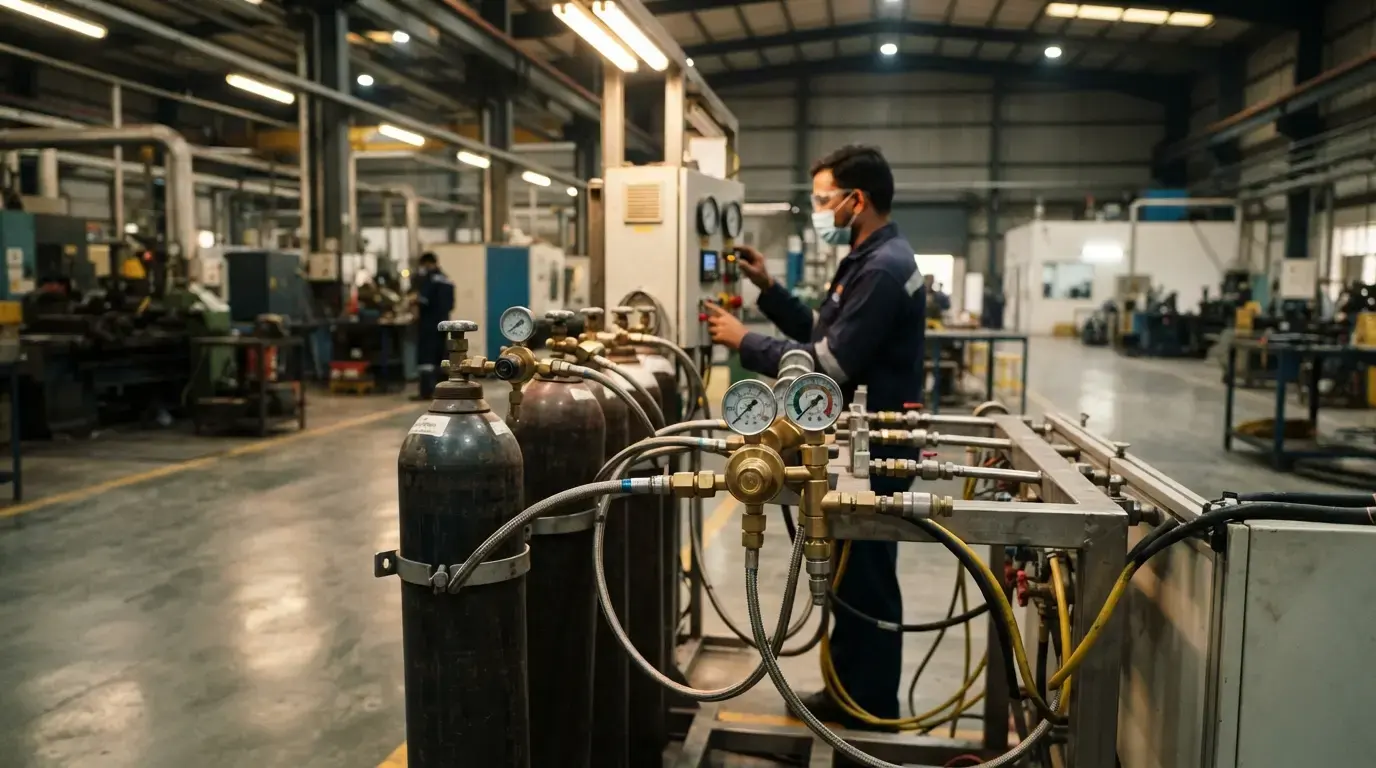
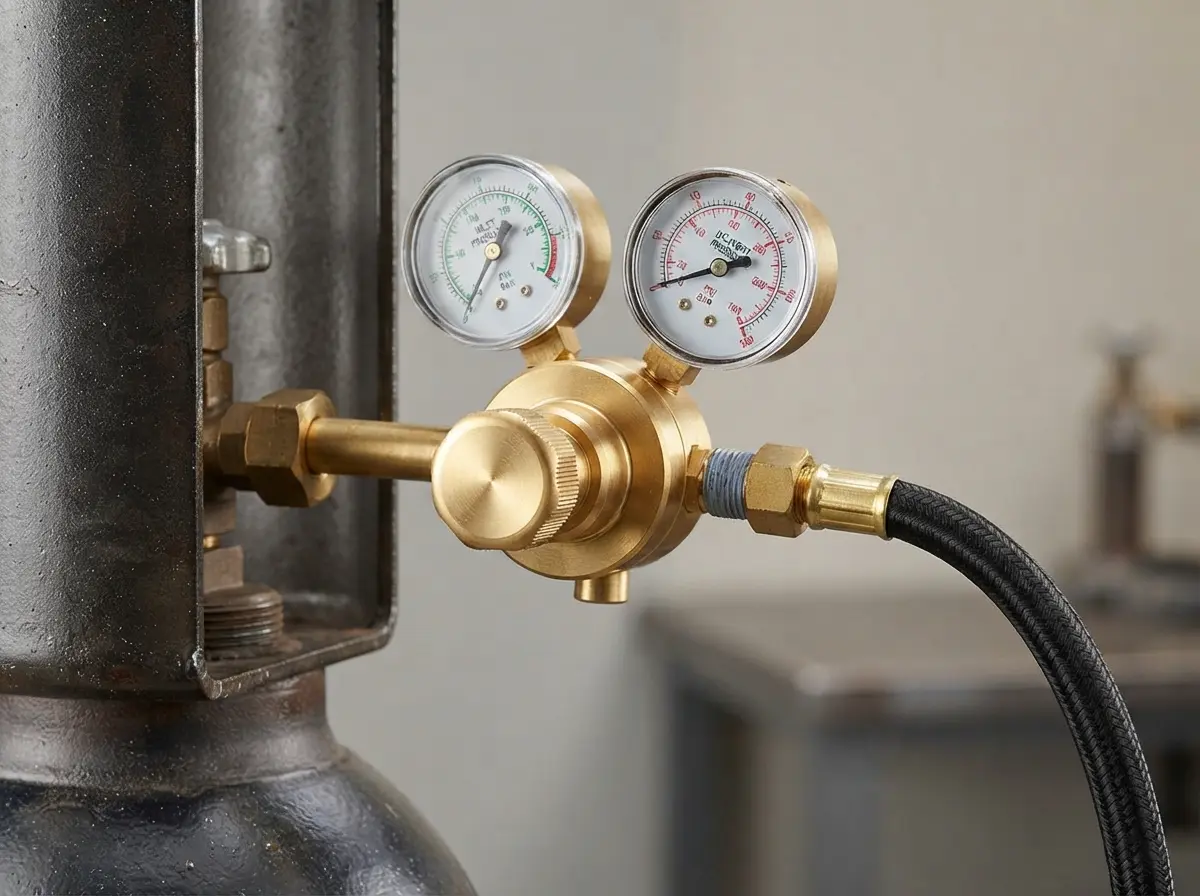
Compressed nitrogen cylinders in India typically store gas at 150 to 200 bar — far higher than the working pressures required by any application. Pressure regulators are the critical link between the high-pressure cylinder and the low-pressure equipment. A regulator reduces cylinder pressure to a steady working pressure and maintains that pressure as the cylinder empties. Choosing the wrong regulator — or fitting it incorrectly — wastes gas, damages equipment, and creates safety hazards.
Matching Regulators to Applications
Different applications require different working pressures and flow rates, which means different regulator specifications:
- MAP packaging lines: 5 to 8 bar working pressure, moderate flow rate (5 to 50 Nm3/h depending on line speed).
- Laser cutting (stainless steel): 10 to 25 bar working pressure, high flow rate (especially for thick material at high power).
- Reflow soldering ovens: 5 to 8 bar working pressure, low to moderate flow rate with tight purity control.
- Tank blanketing: 1 to 3 bar working pressure, low continuous flow.
- Fire-suppression systems: High-flow, rapid-discharge regulators designed for emergency release.
A single-stage regulator is adequate for most workshop and general industrial use. Double-stage regulators hold output pressure more steadily as the cylinder empties, which is important for precision applications like laser cutting and reflow soldering where pressure fluctuations directly affect quality. The regulator must also be matched to the specific gas — nitrogen, oxygen, argon, and CO2 regulators use different thread types, seat materials, and purge mechanisms. Never assume one gas regulator fits another.
Ensure you have the right gas cylinder regulators and accessories alongside robust high-pressure gas cylinder hardware to prevent leaks and pressure drops.
Safety: The Invisible Hazard
Nitrogen's greatest safety risk is also its greatest advantage — it is odourless and invisible. In a confined space, nitrogen displaces oxygen without any sensory warning. At 19.5% O2, the atmosphere is classified as oxygen-deficient and entry requires breathing apparatus. Below 16% O2, judgement and coordination deteriorate. Below 10% O2, loss of consciousness can occur within minutes, and death follows shortly after. Confined-space fatalities involving nitrogen are documented every year in India and worldwide — and they are almost always preventable.
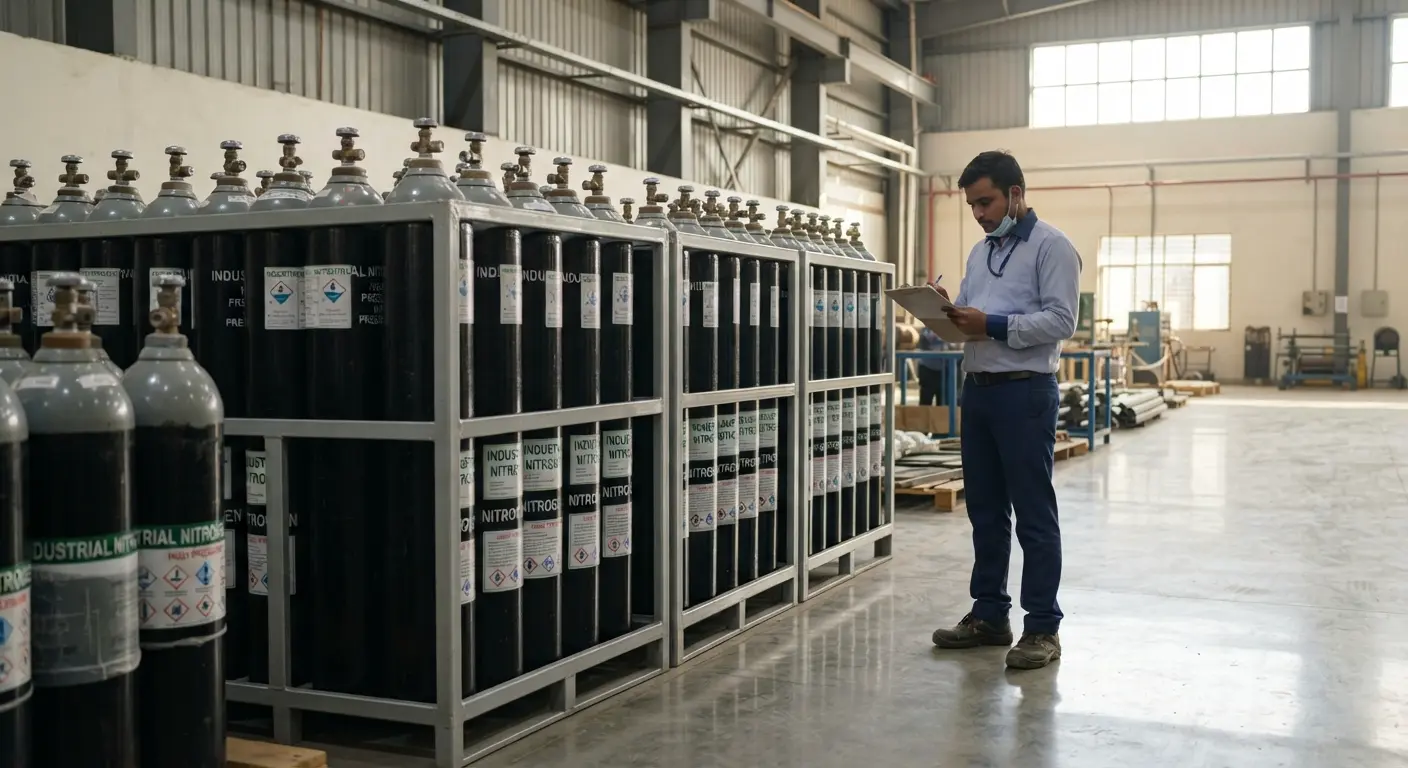
The rules are straightforward: always ventilate confined spaces before and during nitrogen use, always wear a calibrated O2 monitor when working near nitrogen equipment, never enter a nitrogen-purged space without self-contained breathing apparatus, and always follow safe compressed gas transport rules in Bihar when moving cylinders. Nitrogen cylinder safety caps must remain fitted during transport. Valves must be closed when not in use. Cylinders must be stored upright, chained or strapped, and away from heat sources.
India Market Context and Sourcing in Bihar
The India industrial gases market was estimated at approximately USD 3.9 billion by 2023 (Linde expansion data) and is projected to grow at a CAGR of 4.92% through 2030 (TechSci Research), driven by demand from steel manufacturing, chemicals, electronics, food processing, and healthcare. Nitrogen is the single largest product segment by volume, accounting for a significant share of total industrial gas consumption.
The packaged food sector — the primary consumer of MAP-grade nitrogen — is expanding at double-digit rates in India as urban cold chains mature, organised retail penetration increases, and consumer demand for longer-lasting, preservative-free products grows. Food processors in Bihar who adopt MAP capability gain access to wider distribution networks, longer shelf windows for retail, and reduced waste losses.
For manufacturers in Khagaria, Begusarai, Samastipur, and surrounding districts, a local nitrogen supplier means shorter lead times, cylinder availability during peak production seasons, and on-site support for regulator sizing, purity certification, and safety audits. Relying on distant suppliers risks production stoppages when cylinders run low — and in food packaging and laser cutting, even a few hours of downtime can cost more than a month of gas supply.
If your manufacturing unit, fabrication shop, or food packaging plant requires dependable cylinder supplies, contact Prem Gas Solutions today as your trusted nitrogen gas cylinder supplier in Bihar.